Tuesday, February 9, 2010

Minority Religious Groups: Is a 'Religious Test' Okay?

Generally speaking, it is usually religious minorities that are discriminated against, not the other way around. This article, posted on the Yeshiva World News website, explains the controversy surrounding a number of religious groups that have been accused of religious discrimination when selecting the leaders of their organizations. Stemming from a case at Hastings Law School in San Francisco, the National Council of Young Israel (NCYI) recently filed a legal brief in the United States Supreme Court “to defend the right of religious organizations to remain autonomous and to choose their members and leaders without being accused of engaging in religious discrimination.”

Hastings Law School has banned an organization called the Christian Legal Society (CLS), citing some of their practices as violations of the school’s policy on religious discrimination. Although this group’s meetings are open to all students, regardless of religious affiliation, obtaining a leadership position does not come without a religious test. CLS bylaws require “its leaders and voting members to be practicing Christians who abstain from intimacy outside of marriage.” Since the school does not officially recognize the group, CLS has been not been allowed to participate in school sanctioned activities, and has been denied the use of the school’s facilities and email system.

It is no surprise that there are a number of religious groups that partake in similar practices of religious discrimination when organizing themselves. And, when the U.S. Court of Appeals for the Ninth Circuit ruled in favor of Hastings, this sparked a great uproar among many such groups. In response, NYCI has joined forces with the Becket Fund for Religious Liberty to file suit in the Supreme Court on behalf of a coalition of minority religious groups. Kevin J. “Seamus” Hasson, the president of the Becket Fund for Religious Liberty, is quoted as saying “[i]n America, all faiths have the right to be who they are without interference from the government.” If the Supreme Court upholds the ruling from the Ninth Circuit, there will be some very important and detrimental repercussions for many minority (and possibly majority) religious groups throughout the nation.

There are clearly a number of issues at hand when the dust settles with this case. First, the situation specific to Hastings Law School is interesting, as it is a public school that receives money from the government. As we have already discussed a number of times in class, there are going to be some problems associated with government money being spent on certain religious groups (think Pagan Circles at the Air Force Academy). More importantly, though, is that the school has a strict open-member policy that states that anyone is entitled to be a voting or participating member in any group, even if they do not agree with the mission of that group. It is obvious that the CLS is in violation of the school’s policy, but is this policy constitutional? It is one thing to look at a situation like this that is tangled up in school rules, but what happens when we step outside the boundaries of education? How much of an impact will a decision in favor of Hastings have on private religious groups? Will churches and synagogues be forced to open the doors to their leadership to anyone and everyone?

It is my opinion that a certain level of religious discrimination is not only acceptable, but also necessary within a specific set of scenarios. Religious organizations should be able to use a religious test when selecting their leadership and voting members. NCYI President Shlomo Z. Mostofsky, Esq. says that a ruling like this could force the group to alter their century-old core mission. Isn’t that a pretty distinct infraction on the group’s ability to exercise their religious beliefs freely? He goes on to say that if the decision is upheld in the Supreme Court, “it will not be long before the Young Israel Movement will be forced to change its name to Young Atheist or Young Evangelical, and other Orthodox Jewish organizations will lose their identification as well. It is hard to imagine a legal rule that will be more destructive to Torah Judaism in the United States.” Obviously, this case is going to have profound implications for many religious groups for some time to come.

Monday, February 8, 2010

What is Past is Prologue: Faith's Case for Conflict

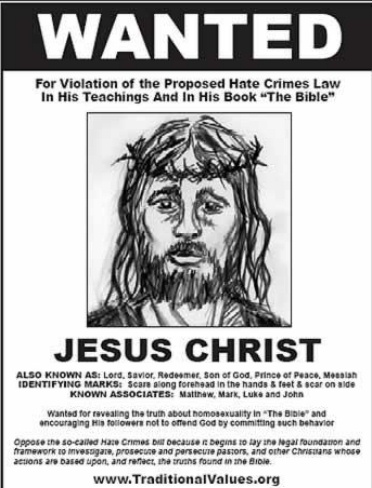
Recently, a Federal law was enacted that elevated crimes committed due to the victim's sexual orientation onto a higher plane of justice. This law, officially titled The Matthew Shepard and James Byrd, Jr. Hate Crimes Prevention Act is not legislation that one would normally assume to be controversial. After all, what law-abiding, respectful citizen could possibly take umbrage with a law designed to crack down on those who commit violent acts in the name of a self-righteous superiority complex?

The Christian Right, is who - or specifically, the Thomas More Law Center of Ann Arbor, MI.

This article explains that the Law Center has filed suit against US Attorney General Eric Holder and claims that the aforementioned act is both unconstitutional and unnecessary. Their argument? That a law designed to limit the group's open bias against alternative lifestyles infringes on their First Amendment rights to freely exercise their religion.

As the article points out, there are a few problems with this argument. First, and most importantly, the law specifically provides for the protection of religious viewpoints, no matter how divisive or biased they may be. It also prohibits " prosecution based solely upon an individual’s expression of racial, religious, political, or other beliefs or solely upon an individual’s membership in a group advocating or espousing such beliefs." Therefore, the actual letter of the law makes it rather clear that no basic religious beliefs are being infringed, persecuted, or prosecuted with this law.

There is an interesting caveat, however. The law's wording also explicitly points out that "the Constitution does not protect speech, conduct or activities consisting of planning for, conspiring to commit, or committing an act of violence."

This leads me to one of two conclusions. Either the Thomas More Law Center has filed a frivolous lawsuit against legislation that they have not actually taken the time to read - or that they endorse speech, conduct, or activities that promote violent acts against those of the homosexual persuasion.

I cannot help but feel that the Center would distance itself hastily away from a public perception that the group advocates violence against those it feels are in the wrong. Why then make all this fuss over a law that does nothing but advance peaceful coexistence between differing groups?

Perhaps also the old worldview that "religious freedom" means "freedom to be a Protestant" is again rearing its head. After all, critics of this legislation are claiming that they are being silenced (when in fact no such persecution is taking place), while demanding that those who claim a different point of view be silenced themselves. One can only hope that the judge hearing this case will see that plain irony on the face of the Law Center's argument. Perhaps then one more voice clamoring for division based on faith will be put in their proper place: the dusty realm of the past.

**To see the full case argued by the Law Center, click here.**

Gay Marriage Puts Mexico City at Center of Debate

Gay Marriage Puts Mexico City at Center of Debate

As Mexican marriage law now stands, gay people have the right to civil unions, not marriages. While the government only legally recognizes civil marriages, not just ecclesiastical ones, this article deals with Mexico City’s new legislation allowing gay couples to marry and adopt children. As the law now stands, only the biological parent of the child is recognized as the legal parent. Mexico has a tradition of a rocky relationship with the Roman Catholic Church. Starting with the Constitution of 1917, Mexico has started to become more secular. The provisions of the Constitution were strictly enforced until around 1980 when the Church started to speak out. The Church became highly outspoken regarding its “eroded” legal status and called attention to major government corruption. With the Salinas government’s plan in 1991 to remove all constitutional restrictions on the Catholic Church the tensions between the Church and the government eased into a much more realistic relationship. However, some strains on the new relationship remained, particularly in southern Mexico in general and in Chiapas in particular.


Forceful disagreement with this new law erupted as soon as word got out. Mexico City is unique in its very liberal leanings, compared with the rest of Mexico-the city has legalize abortion past 12 weeks of pregnancy and has simplified divorce laws. In his final homily of the year, the Cardinal called this law an “attack” on the Mexican family, while President Felipe Calderon said “the Constitution defined marriage as between a man and a woman. Although legal experts refute his statement, his attorney general has filed a challenge before the Mexican Supreme Court, stating that the law breaches a constitutional clause protecting the family. Although Mexican families are torn apart from migration, experts say that the idea of the ‘nuclear’ family is still very important to most Mexicans. Mariana Gómez del Campo, the Mexico City leader of the president’s National Action Party, or PAN, said ““The same word cannot have two different meanings…it will weaken the legal definition of marriage” She also feels that there will be a negative effect on children’s rights, “one of their rights is to have a family…a child does not get to decide what kind of family it is.”

Mexico City’s mayor, Marcelo Ebrard is a social liberal hoping to run for the presidency in 2012. However, he may face some resistance outside of Mexico City, as the Catholic Church still has tremendous power in rural Mexico. Mexico City’s decisions have caused the Catholic Church to speak out-and even begin lobbying. This is significant because the Church has been careful to stay out of politics since their rights were fully restored in 1992.

The main issue here regarding religion and law is how much can lawmakers allow their religious beliefs to affect their policy-making? The President of the country is claiming that the constitution defines marriage as between a man and a woman, but most legal scholars in the country disagree. I think this is salient because Mexico is supposedly a secular state, and yet the President is allowing his religious beliefs to over-ride the laws of his country.

I think this issue is important because it shows that acceptance of gay marriage is clearly not just an American issue. Also, I think it relates to what we talked about last class in that while Mexico is a secular state on paper, the law in action is often much different. When the human aspect is added in, with firmly held beliefs significantly affecting their decisions, the letter of the law can often become very jumbled. I think Mexico is in a very interesting situation because the capital city has significantly more liberal political ideals than the rest of the country. It will be interesting to see how involved the Catholic Church becomes in this issue and what the Supreme Court rules in regards to whether the constitution protects only the traditional ideal of the family.

Is Abstinence Education More Effective than Safe Sex Education?

Both the NY Times and CNN.com had stories this week on a study published in the most recent issue of Archives of Pediatric and Adolescent Medicine claiming that abstinence only programs may be more effective than common safe sex programs at delaying middle school aged children from having sex. The study divided a group of 662 seventh and eighth grade African-American students in urban schools into four different programs. The programs included an abstinence only program, a safe sex program, a comprehensive program covering both abstinence and condoms, and a control group that offered general health information. The participants were polled two years after the program to determine if they had engaged in sexual intercourse. The abstinence only group proved to be the most effective with only 33% of the children having engaged in sexual intercourse. It was followed by the comprehensive program (40%), control group (47%) and the safe sex group (52%).

However, this abstinence only program was not the traditional abstinence only program that one might expect. It did not pressure the children into abstinence, but rather highlighted the ways in which pregnancy and STDs may interfere with the children’s life goals. The children were never taught to abstain until marriage, but rather until they were more mature. If children questioned the teacher about condoms or other forms of birth control, they received medically accurate answers.

Public support for abstinence only education has been a major issue in the American legal system for the past two decades. The American Civil Liberties Union has been involved in a number of lawsuits questioning the use of taxpayer money to promote religion and to disseminate medically inaccurate information. The Obama administration has just recently eliminated funding for abstinence only programs that promote abstinence until marriage, in favor of more diverse programs. Though the abstinence only program from this study does not promote religion, some religiously conservative proponents think that the results may be a step towards the revival of abstinence until marriage programs. This brings to light several questions. Should abstinence only programs such as the one from this study be allowed in public schools? Should abstinence until marriage programs be allowed in public schools? Where do we draw the line?

I believe that it is constitutional to allow “abstinence until mature” programs such as the one from this study, in public schools because they do not promote any religious beliefs. However, I do not think that the programs would be effective for children who have already lost their virginity. Therefore, I think that the programs should be restricted to middle schools in which a majority of the student population has not engaged in sexual intercourse. On the other hand, I do not think that abstinence until marriage programs have a place in any public schools. Though the programs may have a similar message to “abstinence until mature” programs, they impose religious beliefs on participants in a way that “abstinence until mature” programs do not.

Where do we draw the line? I think that it is constitutional to allow all sexual education programs that are medically sound and do not promote abstinence until marriage. Whether or not all programs that adhere to these criteria will be effective is another issue entirely.

Controversial Pancakes

This article from the New York Times describes the events prior to the recently held National Prayer Breakfast. The Prayer Breakfast is an event where top political, military and religious leaders from the United States meet in an effort to network with each other. While the official Prayer Breakfast is held in Washington D.C. there were a host of similar and competing events in major cities throughout the country. On the surface, these events seem to be wholly sponsored by the government. However, this is not necessarily the case. As the article states, the Prayer Breakfast is primarily sponsored and coordinated by the Evangelical Christian group known as “The Family.” This secretive religious group uses its behind the scenes influence in the political realm at various types of these networking events. A major concern about the Breakfast is that a religious group is involving itself directly in political affairs. Many American citizens are not comfortable with having a religious entity, especially one not widely known to the public, influencing powerful political officials.

The main topic of this article involves The Family pushing their anti-gay rights views onto government officials. The Prayer Breakfast is a national forum in which their beliefs can be made evident to the government. While the article explains the implications of allowing this group to articulate their anti-gay sentiments to federal officials, I believe that the Prayer Breakfast shows a more overarching legal and political problem in the United States. The Family, much like any other interest group, has the right to make their beliefs known to government. However, a larger issue forms when the institution sponsoring a governmental event is overtly religious. Should it be permissible for the government to be involved in an event that is sponsored by a specific religious organization? (Below is a video from the Prayer Breakfast which was held last week.)


This question becomes even cloudier considering The Family is not a well publicized group. They have no formal structure and tend to make their impact in Washington without much public recognition. I contend that the problem with allowing groups like this, or any religious group, to sponsor a political event stems from the American ideal of the separation of Church and State. This First Amendment legal issue has become a prevalent topic over the past decade. In this particular instance however, there is a direct overlapping of religious and political institutions. By allowing a group such as The Family direct access to federal officials, it gives the impression that certain religious causes have stronger political influence than others. This in turn, alienates citizens with alternative religious, or non-religious, beliefs. This realization appears to have some severe legal implications. Government officials attending the National Prayer Breakfast goes against every lesson about the necessary aspects of having separate political and religious spheres. While it is the case that any interest group can sponsor an event with prominent politicians in attendance, it seems strange that the largely unknown religious organization The Family is allowed to network annually with the most powerful diplomats of the United States. In my opinion, it is reasonable for individuals, religious or not, to be upset by the involvement of The Family in this event. American citizens should not simply be upset with the fact that The Family sponsors anti-gay sentiments, but rather that religious groups are allowed such direct attachment to political affairs.

A counterargument to my, and many others, issue with the National Prayer Breakfast states that these religious groups should be allowed to voice their opinions to the government just like any other institution. Admittedly, there is no empirical evidence that The Family has any more influence over political affairs than any other interest group in Washington. But this should not be the primary concern of this event. It is undoubtedly the right of every interest group to attempt to garner political support for their causes. In this light, The Family is no different. However, it is the mere possibility of a solely religious influence in the political system that is both politically and legally questionable. Therefore, it is still necessary to question the legitimacy of these types of events. The First Amendment appears to get blurred when top leaders from both spheres “network” over a fresh stack of pancakes. But given the long lineage of government officials attending this event, it appears that nothing will be changing in the near future.


Justin M.

Sunday, February 7, 2010

Death is a civil matter

Parents found guilty in Oregon City faith-healing trial


As if placing one’s faith in one’s creator was not difficult enough, in Oregon City, Oregon it is apparently illegal. Jeff and Marci Beagley were found guilty of criminally negligent homicide for the 2008 death of their sixteen-year old son. Read the article.

I found three interesting, yet disturbing, comments in the online article. First is the warning by Steven Green, director of Willamette University’s Center for Religion and Democracy, that this case sends a signal to the religious community [presumably at large] that their actions will be more scrutinized [by the state than a non-religious community]. A family that chooses a faith path that endorses faith-healing can be held to a higher standard of child care than a more secular one that over-medicalizes their child(ren). These faith-holding parents differ in the court from another parent who sends their child to the doctor, demanding care the child may not need (I am thinking of Ritalin prescriptions or antibiotics for treating the common cold) and that may do more harm than good, because they chose to place their faith with a different authority. I understand the continuous court rulings that beliefs and actions take different legal roads, but I also see a definite pattern of hypocrisy. There are too many examples of questionable parenting (for example) that go unrecognized in the court system even when the result is the death of a child; the parent seems to be saved because they do not profess to a strong sense of faith for their lives.

The second comment that bothered me was that expert testimony of doctors was used by the defense even though the parents did not rely on their medical skill to take care of their child when he was severely sick. As the prosecution attorney offered, this was a “rich irony.” Yet, what other alternative did the defense have? Death, in our society, apparently is a civil matter and not a faith matter. No matter how many faith healers and examples of successful faith healing the defense could have offered as proof that faith healing works, the secular/civil court most likely would not have recognized its relevance. Their son died under their care, not God’s care. It did not help that no one bothered to call 9-1-1 when he died—a repeat in the death of the same parent’s granddaughter three months earlier.

Finally, we are told that in Oregon, parents who offer a religious defense in the death of a child may receive probation instead of a prison sentence. If the state is going to go after parents for their decisions in the death of their child, the state should use the same criterion for all parents. What, after all, does the religious defense do that changes the circumstances? Repeatedly, the courts have ruled that actions fall under a different set of rules. There is no reason, therefore, to slap parents with criminal suit and then offer some a carrot because their actions were based on faith decisions.

I have found that reading comments following articles online incredibly eye opening. The viciousness that people exhibit in their commentary regarding those who rely of faith so strongly is as close-minded as the people they accuse. Is there any difference in the comments following this article and that found against Native-Americans in 1892 when the school superintendent wrote, “their religion is the darkest of superstitions” that inevitably led to a “lack of truthfulness, consistency, and moral consciousness” (Wenger, p. 29)? The conflict between authorities, the state and God, is an old one that surely will not end very soon.

Good Intentions or Good Excuse?

http://www.cnn.com/2010/CRIME/02/04/haiti.arrests/index.html


In the wake of the earthquake that struck Haiti, 10 American missionaries were arrested for kidnapping. We’ve heard countless stories of how this earthquake has devastated the capital of Haiti. Songs have been made and stories have been told in an effort to rally support and aid for Haiti. Some have even left their homes in various countries and on various continents in order to physically lend a hand to Haiti. Of the 10 Americans that were arrested some belong to a Baptist church that’s based in Idaho. As I read this article my heart was broken a little by the thought of someone even seeking prosecution against a group that means no harm. I guess the question that resonates over and over in my mind is: “Does a natural disaster like this one trump certain laws and traditions?” If your city lies in ruins and the reality of the life’s temporality is shaken, what exactly is more important? Laws or lives?

Not only does this case involve Americans but it was also suggested that the case be tried on American soil. It disturbs me that there is even a case to be considered for American justice. Many headlines depicted Haiti as relying on faith and God to get them through this horrible disaster. Yet they seek to arrest and convict the saints sent to them for help. In the midst of devastation should man’s need for social order override the needs of those that are suffering? Can Haiti be so hell-bent on legalities that the children and families are forced to suffer further? I propose that in instances like these that measures of “good faith” should trump minor legalities.

So here’s my advice to fellow Americans and others. Remember the instance with the 2 Korean-American journalists trespassing into North Korea? Well let’s just remember that if we aren’t in America we are guests. Behave as such!


Tuesday, February 2, 2010

Christian Punishment?


Elizabeth Landau’s CNN piece http://www.cnn.com/2009/HEALTH/09/16/spanking.children.parenting/index.htm examines the social implications of using corporal punishment to discipline children, especially those from low income families. Over 2,500 toddlers (12-36 month old) participated in a Duke University study that sought to provide a link between aggression and corporal punishment. The article goes on to note that “spanking is most commonly used among parents who were spanked themselves, who live in the South, and/or who identify themselves as conservative Christians”. The study found that children spanked as one year old's were more aggressive two year old's and tended to perform at lower cognitive levels than their peers. In an apposing view, Robert Larzelere, a professor of human development and family science at Oklahoma State University, finds that spanking children between the ages of 2 and 6 is the best method of discipline.


Southern Conservative Christians are identified as one of the groups most likely to use corporal punishment to discipline their children. This seems to be a generalization that may stem from that particular group’s public declarations of their dedication to use biblical theories to inspire their family, social, and political actions. Spanking children is a legal act in the United State, but abusing children is not. The Duke study infers that there is a link between a child being spanked and later perpetuating physical violence.


I don't believe that parents who choose to spank their children are necessarily motivated by their personal religious leanings. Most parents choose to discipline their children physically because they, themselves were disciplined similarly and consider spanking to be the most effective method. I am from the South, but I am neither conservative, nor particularly religious. Yet, when I begin my family, corporal punishment will be implemented at the appropriate times. Corporal Punishment sounds so harsh, and brings to mind images of a child being tied to a pole and a mother wearing an Army uniform, whipping a child senseless. Spanking should have parameters. Popping hands and bottoms with an open hand is perfectly acceptable to me. Talking to a child as if he were an adult, attempting to reason with someone who has 2 years of reasoning experience, is not acceptable. An exception would be made in a special case where a 2 year old has the reasoning of an adult thinker. I remember being spanked as a child. The few times that this occurred, I had behaved in direct defiance of my parent’s direction and a 12” wooden ruler named “Mr. Brown” promptly found the back of my legs and arms. The memory of the fear and physical pain that Mr. Brown bestowed upon me came to mind any time that mischief presented itself to me. Spanking was not related to the religion of my house, it was about establishing practical actions and respecting authority. I think of the many teens today that were only exposed to time-out and verbal warnings, many of whom treat their parents as their peers and have no concept of authority. They seem to be totally unaware of potentially disastrous effects of their various misdeeds. These kids were not referred to in the Duke study, but they should have been. “Aggressive” teens, with no fear of retribution, are nothing compared to aggressive Conservative Christian toddlers at day care.

Monday, February 1, 2010

The Use of the Ten Commandments in Court

I’d like to bring your attention to two articles regarding the same court case. First, the short article that describes Soloman Dwek being grilled on his adherence to the Ten Commandments. Second, the article that explains why the defense thinks this grilling is relevant.


In class last week, we discussed constitutional vs. common law. Oversimplified, constitutional law refers to that which protects common law (it is written out and agreed upon at a given time). Common law, on the other hand, is constantly developing by the people based primarily on customs.


I think that this these news articles demonstrate the way in which constitutional and common law may play out in the court room. Soloman Dwek became an FBI informant after being caught in the fraudulent bank deal referenced in the second article. He then led to the prosecution of several high-level New Jersey politicians. Now, the defendants want to show that Dwek is of low moral character. In doing so, the defense hopes to call into question the FBI’s choice in people they use to prosecute these politicians.


It seems that this move is a last resort for the defense in this case. They merely want to expose Dwek as “just as bad” (or worse) as the defendants in order to undermine the FBI and its efforts. For our discussion, the interesting part is that the defense chose to use the Ten Commandments as the measurement of Dwek’s moral character.


The use of the Ten Commandments assumes that the audience (most importantly the jury) is sympathetic to the moral code that the Ten Commandments assert. I think that the use of the Ten Commandments in this case represents the invocation of common law in the courts. If this is the case, the most relevant habits of Dwek would be his habit of lying. If Dwek was a habitual liar in the past, how can he be trusted in working for the FBI? The defense wants to call Dwek’s credibility into question further by proving that he even cheated and stole from his own family and Jewish community. I wonder how much weight this probing against Dwek will have when he has handed over filmed encounters with the defendants discussing their corrupt dealings? Will the jury value the defense’s questioning of Dwek’s character enough to oversee the evidence provided by Dwek? I don’t think this is very likely but I guess it is worth a shot for the defense.


It seems that the evidence provided by Dwek should be used to in the case against the defendants and then Dwek can be dealt with on his own. Sure, he probably only cooperated with the FBI for selfish reasons but that does not change the fact that the defendants are corrupt themselves.

Is There a Place for Forgiveness ?: The Polanski Case

Many of us are now probably familiar with the Roman Polanski rape case. In 1977 Polanski was convicted of having “unlawful sex with a minor.” Reading through the transcripts of the victim, 13 year-old Samantha Geimer, one learns that Polanski gave the girl a quaalude and champagne before engaging in sexual intercourse with her. According to her testimony, she repeatedly told him “no” and resisted his sexual advances. After a lengthy trial, which ended with much still up in the air, Polanski fled to Europe. He has been living there for over 30 years (For a nice summary see here)

So what makes this case interesting for those interested in Religion and American Law? In 1997, Geimer publicly “forgave” Polanski. For one interested in the intersection of religion and law, the case raises the important question: Does forgiveness, a nominally Christian concept and virtue, have a place in the American law system? Many people’s immediate reaction is probably to say no. And this most likely reflects a general understanding of how crime is dealt with in the U.S. legal system (This is specifically talked about here). Our law centers, in general, around a retributive form of justice, one in which criminals have to “pay” for their crime with their time, labor, or life. Forgiveness flies in the face of this form of justice. Even if forgiveness occurs, some might claim, it cannot stand in place of punishment

Public reaction to Polanski has been mixed to say the least. Many celebrities have stood up for him. During the 2003 Oscars, for example, he received a standing ovation from the audience when he won for Best Director for his film The Pianist. Some feminist thinkers have reacted strongly as well (Check out the reaction at feministing). Many of the proponents of his arrest claim that he has been able to evade facing his crimes because of his celebrity status. If we do not seek to punish him to the fullest extent of the law then we are, as a society, authorizing his crime. They argue that it begins to look like rape is permissible as long as you can make a good movie. How can we as a society allow this?

In a more sympathetic portrayal of Polanski’s life, the film Roman Polanski: Wanted and Desired describes Polanski’s struggle for survival after his mother as killed in the holocaust and the Manson family murdered his wife. This story might lead one to think that while Polanski committed a terrible crime, it is reasonable to feel sympathy for him.

To make matters more interesting, Samantha Geimer has fought to have the case dropped since Polanski’s recent rearrest in Switzerland. It appears she has moved on since forgiving Polanski back in 1994 and wants everyone else to as well. Perhaps her forgiveness is not “pure,” in the sense that she has extended a sympathetic embrace to him, but I think most would be hard pressed to find a pure form of forgiveness. In either case, Geimer's attempt to have the charges dropped might make us reconsider whether forgiveness should have a place in the law. If both the victim and the perpetrator are ready to move on, why should the law stand in their way?

The point of this short blog is not to advocate releasing Polanski’s case being dropped, nor to advocate punishing him to the fullest extent of the law. Instead, it is to point to the ambiguity that a victims forgiveness brings into the law, and to have shown how it might not always be clear whether punishment or forgiveness is the best route to take. Further, this case also raises the issue of whether forgiveness permissible in the legal arena. Is it a purely “religious” concept? And what role do nominally Christian or religious concepts play in society more generally?


As this article states, the United States Air Force Academy in El Paso County, Colorado, has recently dedicated space for a sacred pagan circle. The Academy already has dedicated sacred spaces for Catholics, Protestants, Jews, Muslims, and Buddhists. Tech. Sgt. Brandon Longcrier (pictured at right, consecrating an Earth-centered worship site with white sage--photo courtesy of U.S. Air Force, Staff Sgt. Don Branum) was the driving force behind this circle’s creation, but he thanks the chaplain’s office for its support and says that there was no intervention or interference against the dedication of a sacred space for his religion. A similar sacred circle was destroyed several times at the Army’s Fort Hood in Texas.


The article hails it as a triumph of religious freedom, and I agree. It quotes the Cadet Wing Chaplain, Lt. Col William Ziegler, who says, “We want this dedication service to be another example of celebrating the freedom we enjoy as well as the freedom we, as Airmen, have pledged to defend.” This is a fine example of the epitome of state-sponsored schools offering religious spaces for all of its students. However, the question then becomes, where is the line drawn?


Some people will attack the sacred circle on the grounds that there is no one God that the Earth-centric religions pray to, even if that argument is potentially irrelevant, especially as there is a Buddhist sacred space at the Academy already. They will make the argument, however, that a “true” religion has a specific deity at its head, instead of a number of deities or a focus on the natural world.


Others might argue that having separate spaces for all of these religions is implicit government support of these specific religions to the exclusion of the others not represented. Others may say that religious spaces have no place on the campus of a government-run and –funded institution, and that if the cadets at the Air Force Academy wish to attend religious services of any type they must seek it in the community. The idea of government-owned, consecrated land could be seen as an establishment of religion.


I agree that the precedent may be mildly worrying, but I also believe that it was the right thing to do. The chaplain’s office will just have to evaluate other cadets’ religious needs as they arise, and find the medium between respecting each religion and the very small populations of certain religious groups. There are religions common in the United States not mentioned as having sacred spaces of their own at the Academy, including Hinduism and the Native American Church. The article does not comment on whether there are any practitioners of either of these religions, but the reader is left to wonder if a Hindu or Native American Church sacred space will follow at the United States Air Force Academy. Again, I do not necessarily see a problem with that; however, it must be considered that at a certain point the areas of campus dedicated to different religions could outnumber the secular areas.


However, Sgt. Longcrier and his peers who follow Earth-centered religions now have a place to call their own, and this is only fair considering that his fellow cadets who happen to be Catholic, Protestant, Jewish, Muslim, or Buddhist are offered the same courtesy.