
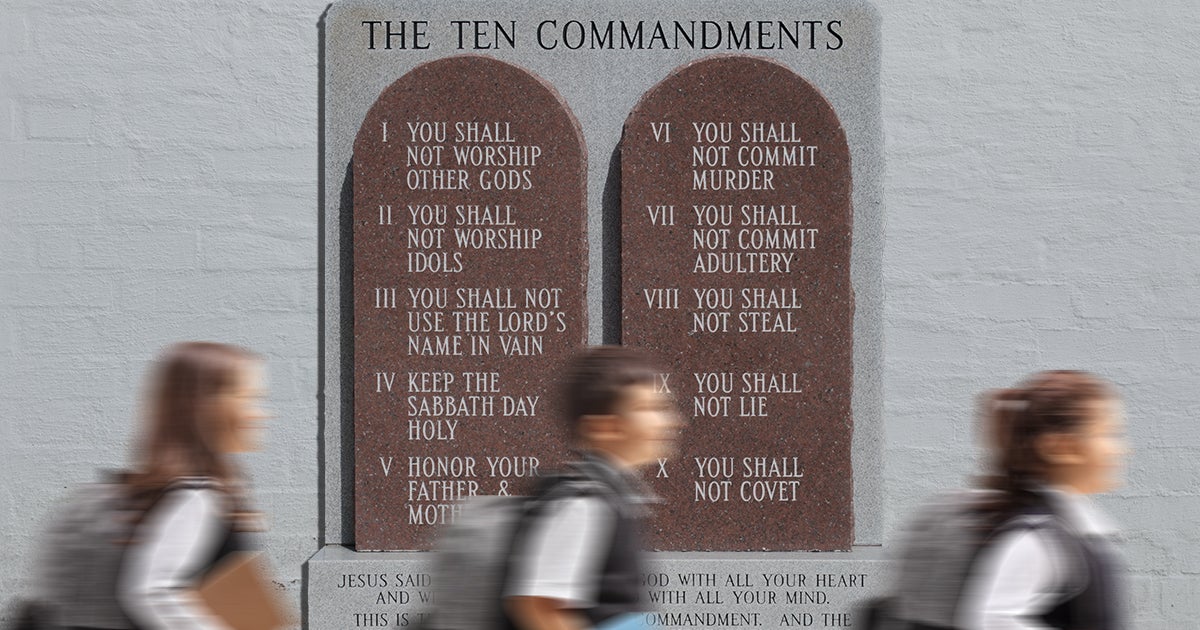
In 2025, Louisiana enacted House Bill 71, a statute requiring that every public school and public university classroom display a state-approved version of the Ten Commandments. The law specifies the text that must be posted and requires that it be accompanied by a statement describing the Commandments’ historical significance in the development of Western legal systems. Almost immediately after its passing, parents and civil liberties organizations filed suit in federal court, arguing that the mandate violates the Establishment Clause of the First Amendment. Although a federal district court initially prohibited the law, the United States Court of Appeals for the Fifth Circuit later lifted that injunction while rehearing the case, allowing the displays to proceed as litigation continues. The Supreme Court has not yet addressed the merits, leaving the constitutional question unresolved.
The controversy centers on a familiar but persistently difficult issue: whether the government may require the display of a religious text in public school classrooms. Louisiana lawmakers defend the statute as an educational measure. In their view, the Ten Commandments are presented not as theological instruction but as a historical source that influenced Anglo-American legal traditions. The state contends that acknowledging this influence does not amount to religious endorsement. Plaintiffs, however, argue that the law compels the state to place a sacred text, one that begins with commands regarding the worship of a particular deity, at the center of the public classroom. In their view, that mandate crosses the constitutional boundary separating church and state.
The most relevant precedent is Stone v. Graham. In Stone, the Supreme Court invalidated a Kentucky statute requiring the posting of the Ten Commandments in public school classrooms. Applying the Establishment Clause framework then in use, the Court concluded that the statute lacked a genuine secular purpose. The classroom setting was pivotal to the Court’s reasoning. Because students are compelled to attend school and are particularly impressionable, the government must avoid actions that appear to endorse religious doctrine. The Louisiana statute closely resembles the law struck down in Stone, and it is difficult to ignore that similarity. Supporters of the new measure appear to anticipate judicial reconsideration of that precedent.
Other Supreme Court decisions, however, complicate the analysis. In 2005, the Court decided two cases involving public displays of the Ten Commandments that produced different outcomes, McCreary County v. ACLU of Kentucky and Van Orden v. Perry. In McCreary County, the Court struck down framed Ten Commandments displays in county courthouses, emphasizing that the displays’ history and presentation suggested a predominantly religious purpose. By contrast, in Van Orden, the Court upheld a Ten Commandments monument on the Texas State Capitol grounds, noting its placement among numerous historical markers and its longstanding presence. These decisions suggest that context and purpose are critical in determining whether a display constitutes impermissible endorsement.
Yet the classroom context remains distinctive. Unlike a monument on capitol grounds, which citizens may choose to approach or ignore, a classroom is a mandatory environment. Students do not enter it voluntarily, nor can they easily avoid exposure to what is displayed there. The power dynamics inherent in public education, where the state sets the curriculum and teachers exercise authority, heighten concerns about governmental endorsement. Even if the legislature characterizes the posting requirement as historical, the content of the Ten Commandments is candidly religious. Several of the commandments concern duties owed directly to God rather than civic norms. That theological dimension distinguishes the text from secular historical documents.
Supporters of the Louisiana law may argue that modern Establishment Clause doctrine has shifted away from rigid tests and toward an emphasis on historical practices and understandings. They might contend that references to the Ten Commandments appear throughout American public life and that excluding them from classrooms reflects hostility toward religion rather than neutrality. In recent years, the Supreme Court has indeed shown greater willingness to accommodate religious expression in public settings. However, there remains an important distinction between accommodating private religious expression and mandating state-sponsored religious display. The Free Exercise Clause protects individuals’ rights to practice their faith without government interference. It does not necessarily authorize the government itself to promote a sacred text in a required educational setting. If constitutional neutrality means that the state neither favors nor disfavors religion, then requiring the display of a specific religious code in every classroom risks signaling preference.
In my opinion, Louisiana’s law is unconstitutional because it conflicts with the purpose of the Establishment Clause. Even if lawmakers describe the postings as correlated to history, the Ten Commandments are not just a historical document. They are a sacred religious text that begins with commands about worshipping one God and rejecting other gods. Requiring that text to be displayed in every public classroom does more than acknowledge religion’s influence, it sends a message that the state is endorsing it. And because the law applies to every public school classroom in Louisiana, that message is not subtle. This is not a small plaque in a museum or a monument surrounded by other historical symbols, it is something students will see every day in a place they are required by law to attend. When the state requires a religious text to hang on the wall, it inevitably carries the impression of government approval. For students who practice different religions, or who are not religious at all, that display can reasonably feel like a signal that the state favors one tradition over others. That is exactly the concern the Supreme Court raised in Stone v. Graham, and those concerns still make sense today. Teaching about religion’s historical influence is one thing, mandating the display of a sacred religious code in every classroom is another.
https://lailluminator.com/2026/02/20/louisiana-ten-commandments-4/
https://www.oyez.org/cases/1980/80-321


10 comments:
I agree with your analysis Theresa. I think the most compelling reason to rule this Louisiana statute unconstitutional is the context and manner in which these posters would be displayed. I do find the appeal to history of the Ten Commandments to be compelling and I can understand why the Court ruled the way that it did in Van Orden. Overall though, considering children being at an impressionable age and requiring the Ten Commandments in public classrooms when students are mandated to be there, it is hard for me to see a compelling constitutional reason to allow this to occur. If I were the defendant, I would assume the strongest constitutional argument is that these displays remind students of the history of the country and as you said “the development of legal systems” rather than being solely religious displays … that seems like a hard argument to make considering the other context. But who knows.
I agree that this law is unconstitutional. As Theresa mentioned, the commandments contain persuasive text that calls for the reader to only accept one specific deity. However, had the posted commandments not contained that portion, I think there would be a strong case for this law being constitutional. I also think funding is very important in cases like this. If these are publicly funded I believe that would make this unconstitutional as well.
I agree with your analysis, Theresa, that this regulation/legislation is unconstitutional. I think the point that you made about the classroom being a mandatory environment is a very strong point. I think you are absolutely right in your statement that even though posting the Ten Commandments in a classroom and on a statue/plaque on government grounds are government-funded, they are very different in the way that they are administered to the masses. While they are both very publicly facing, you have the choice in one of these situations to recognize their presence; in a classroom, your exposure to them is not as optional. I am curious, however, to see how the Supreme Court rules in this case regarding the jurisprudence that exists surrounding the topic.
I agree with your final opinion as the display of the Ten Commandments in public settings violates the Establishment Clause in the First Amendment. Although they try to spin it as a historical artifact, it has strong religious connotations that should not be prominently displayed in public settings because of the possibility that it could intimidate and coerce individuals. I feel like this has become a much more common issue in recent years, and this will certainly not be the last time we will be hearing about it.
I agree with Theresa on this case. Requiring the Ten Commandments in all classrooms sends a message that the state is endorsing one particular religion, especially due to the fact that they do not require any other important historical religious texts to be displayed. Additionally, students do not have a choice in attending school, and your point about this makes a lot of sense, as students would be required by the state to see the Ten Commandments all day long.
I agree that the statute is unconstitutional. While the Louisiana government may argue that the Ten Commandments have a historical significance, there is no question that they are also a religious document. Therefore, the state is funding and supporting one religion over others, which is unconstitutional. To prevent a law like this from violating the Establishment Clause, the state would have to publicly fund and require that schools place certain religious documents from every religion, which is illogical.
I agree that displaying the commandment in all classrooms is more than acknowledging history and can be considered as an establishment of religion. Public schools and the government must remain neutral with religions and this breaks neutrality. This same concern was expressed in Stone v. Graham as stated, and the reasoning for it applies to this case. If they are displayed in classrooms, it can also make students who believe in other religions feel excluded or unwelcome.
I agree. The Establishment clause restricts state promotion of religion(s), including signaling preferences. Case precedent (“McCreary”) prohibited Ten Commandments (“TC”) displays in courthouses: concerned displays would imply religious preferences. In contrast, Louisiana Lawmakers might argue a TC display was allowed outside the Texas State Capitol. However, public school classrooms are different for two reasons. First, classrooms lack other historical markers for contextualizing displays. Second, compulsory attendance risks signaling religious preference to impressionable child minds.
I agree. Displaying the 10 commandments in a classroom is a full establishment of religion. If their goal is to acknowledge religious history, then including more than one religion would be the correct course of action. This violates the Establishment Clause.
I agree with your opinion. While the state of Louisiana claims that the mandatory display of the Ten Commandment in public schools is secular, it is inherently religious. The state cannot claim that since they intend for its effect to be purely historical and secular, that it is. Whether or not they mean to, the Ten Commandments are inseperable from religious as they derive from the Old Testament. With this, their display violates the Establishment Clause as it endorses the text's related faiths. The signs are also being hung in publically funded schools, which is unconstitutional regardless of whether or not the copies of the Commandments are publicly funded.
Post a Comment