
In recent years, disputes over religion in public life have extended beyond schools and legislative settings into new and more complex areas. One such controversy is presented in Freedom From Religion Foundation v. Mack, a case involving a Texas judge who incorporated prayer into his courtroom proceedings. Before hearings began, Judge Wayne Mack would invite those present (litigants, defendants, attorneys, and observers) to stand for a voluntary prayer, sometimes led by himself or by a chaplain. Although participation was not formally required, the practice took place within the formal structure of judicial proceedings. The Freedom From Religion Foundation challenged this practice, arguing that it violates the Establishment Clause of the First Amendment. While lower courts have grappled with the issue, the Supreme Court has not yet issued a definitive ruling, leaving the constitutional question unresolved.
The controversy raises a familiar but difficult issue: whether a government official may incorporate religious expression into an official proceeding without crossing the line into unconstitutional endorsement. Judge Mack and his supporters defend the practice as voluntary and consistent with longstanding traditions of public prayer in American government. They argue that such expressions reflect the historical role of religion in public life and do not compel participation. The plaintiffs, however, contend that the courtroom context fundamentally alters the constitutional analysis. Unlike legislative settings, where individuals may observe or leave freely, those in a courtroom are subject to judicial authority and may feel pressure to conform. In their view, prayer in this setting carries an implicit coercive force that violates the Establishment Clause.
The most relevant precedents are Marsh v. Chambers and Town of Greece v. Galloway, both of which upheld the constitutionality of legislative prayer. In Marsh, the Supreme Court emphasized the historical tradition of opening legislative sessions with prayer, concluding that such practices were deeply embedded in the nation’s political history. Similarly, in Town of Greece, the Court upheld sectarian prayers at town meetings, reasoning that they were permissible so long as they did not coerce participation or discriminate among faiths. These decisions suggest that government-affiliated prayer is not inherently unconstitutional and may be permissible when rooted in tradition and conducted in a non-coercive manner.
However, the courtroom setting presents a critical distinction. In both Marsh and Town of Greece, the Court relied heavily on the voluntary nature of attendance and participation. Legislative sessions and town meetings are, at least in principle, forums that individuals may choose to attend or avoid. A courtroom, by contrast, is a mandatory environment for many participants. Defendants, litigants, and witnesses are often required to be present and cannot easily opt out of proceedings. This difference raises serious concerns about coercion. Even if prayer is formally optional, the authority of the judge, who controls outcomes and exercises significant power, may create pressure to participate. The presence of that authority complicates the assumption that such prayer is genuinely voluntary.
This distinction also highlights a broader issue within Establishment Clause doctrine: the role of context in determining whether a government practice constitutes endorsement of religion. The Supreme Court’s more recent decisions have placed increasing emphasis on historical practices and traditions. Yet tradition alone may not resolve cases where the surrounding circumstances differ in meaningful ways. The courtroom is not just another public forum; it is a site of adjudication, where individuals’ rights, obligations, and liberties are directly at stake. The power dynamics in that setting amplify the potential for perceived or actual coercion.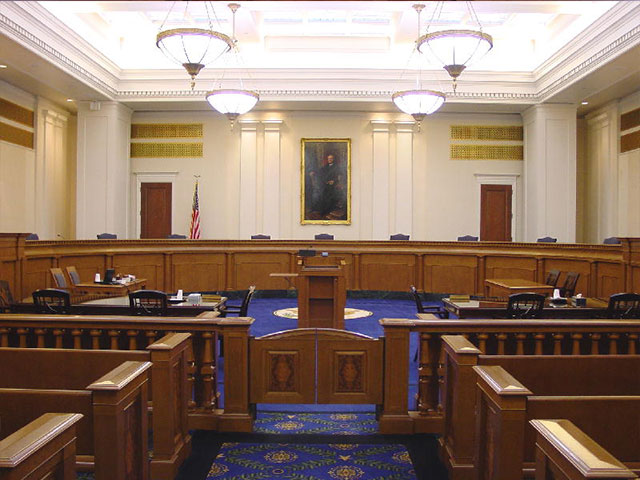
In my view, Freedom From Religion Foundation v. Mack demonstrates the limits of extending legislative prayer precedents into fundamentally different contexts. While Marsh and Town of Greece support the idea that some forms of government-associated prayer are constitutionally permissible, they do not fully account for the coercive pressures that may arise in a courtroom. The Establishment Clause is not only concerned with explicit compulsion but also with subtle forms of pressure and the appearance of governmental endorsement. When a judge invites or leads prayer as part of official proceedings, it risks signaling that participation is expected or favored, even if not formally required.
In my view, Judge Mack’s practice is unconstitutional. Although some lower courts have been more receptive to extending legislative prayer precedents, I agree with the reasoning advanced by the plaintiffs that the courtroom context introduces a level of coercion that those precedents did not contemplate. Marsh and Town of Greece cannot simply be transplanted into the judicial setting without accounting for the fundamentally different role of a judge. The Establishment Clause is designed to prevent the government from placing its authority behind religious practice, and when a judge invites or leads prayer as part of official proceedings, that authority is unmistakably present. Ultimately, this case highlights the importance of context in interpreting the First Amendment. The line between permissible acknowledgment of religion and unconstitutional endorsement is not always clear, but it becomes sharper in environments where power and vulnerability intersect. Extending legislative prayer practices into that space risks undermining the principle of governmental neutrality that the Establishment Clause is meant to protect.
https://www.oyez.org/cases/2013/12-696
https://www.oyez.org/cases/1982/82-23
https://harvardlawreview.org/print/vol-135/freedom-from-religion-foundation-inc-v-mack/


11 comments:
I agree greatly with Theresa's analysis of the case. The possibilities of coercion within this case have not been a factor when deciding on Marsh and Town of Greece. The court is a space in which many individuals are required to be, and at times, they may see each other repeatedly. It can be hard to state whether or not an individual may be coerced in order to preserve their place within the courthouse.
Thanks for this post Theresa. You raise some important points and I am inclined to agree with you and side with the plaintiffs as well. I think a compelling argument can be made that the context – in this case in a court setting where everyone is required by law to be there – is a big enough difference from circumstances in the other cases you mention that would qualify this as a violation of the Establishment Clause. I was thinking what if one party during the Court session did not participate in the prayer and then the Judge noticed that and held that against them later on in the proceedings…
I agree with your stance. I believe it is also unconstitutional because part of being a judge is presenting yourself as an unbiased and neutral individual, and when you lead prayer, then I think that violates this principle. Although this prayer may not be supporting a specific religion, it is coercing and discriminating against non-religious individuals.
I agree with the point about how the courtroom setting changes the analysis compared to other past cases such as Marsh v. Chambers. Even if the prayer is technically voluntary, the judge makes it feel less optional for those involved. It matters because people in court do not have the same freedom to leave or ignore the situation, making coercion a concern. This supports the conclusion that the practice is unconstitutional because it could violate the establishment clause.
I agree. Judges are supposed to be impartial and serve as a leader and decision maker within a courtroom; personal convictions have no place there. Coercion could be possible, in addition to perhaps corruption if someone does not agree with your personal sentiments. I think its definitely a slippery slope.
I agree with your overall opinion on this case, especially given that judges possess so much authority that their engagement in prayer is more likely to appear coercive, regardless of if the practice is voluntary. However, you mention that legislative sessions and town meetings have more voluntary attendance, whereas courtroom hearings do not. I would pose a small caveat that legislative sessions are very mandatory for people in Congress, while there are more people voluntarily at courtroom hearings, such as a spectator audience. Nonetheless, I still think your overall argument is correct in that Judge Mack's prayer is unconstitutional based on his authority and thus close religious entanglement with the state.
I definitely agree with you here. I especially see your point that Marsh and Galloway don't really apply to courtrooms since it's a different dynamic. Courtrooms are environments where attendance is mandatory for those in attendance, making the prayer more coercive in nature. Since the judge holds authority in the room, there is obviously pressure that could prove to be harmful.
I agree with you here as well. I think that the main distinction here is coercion. As a party in any case that Judge Mack was a part of I would absolutely feel compelled to join the prayer because this person is about to make an important judgement in regards to me. If there was no coercion involved however, for example if a chaplain was providing this prayer, I would decide differently due to historical tradition and precedent.
I agree with your analysis on this case. I believe that with voluntary prayer there are occasions where there is no coercion, but I think in this case that is the biggest issue at hand. Even if prayer in a court room is voluntary, one who is trying to defend themselves will feel more compelled to join in trying not to get on the judges “bad side.”
I agree with your analysis on this case and think it highlights the fact that we should not rely on precedents to influence decisions. It is clear that Judge Mack’s practice is coercive and undermines the governmental neutrality the Establishment Clause is meant to protect.
I agree with you as well. The biggest issue with praying in courtrooms and even other government meetings is the issue of coercion. If the judge prays before a hearing, both sides of the argument might break their religious beliefs in order to get on the judge's good side, so they have a better chance of winning the case. They want to appeal to the judge to give themselves a better chance.
Post a Comment