Friday, February 27, 2026

United States Conference of Catholic Bishops v. O’Connell: Can the Court Determine Fraudulent Activity within Peter’s Pence Annual Collection?

    On January 22, 2020, David O’Connell filed a punitive class-action complaint against the United States Conference of Catholic Bishops (USCCB) in federal district court. O’Connell filed this complaint claiming that the USCCB committed fraud, unjust enrichment, and breach of fiduciary duty. O’Connell claims that he donated an unspecified amount of money to Peter’s Pence after hearing a solicitation from the pulpit during a Sunday Mass in the summer of 2018. He does not identify the speaker nor the contents of the message. O’Connell alleges the USCCB led him to believe that his donations to Peter’s Pence would be used only “for emergency assistance” to “the poor” and “victims of war, oppression, natural disaster, or disease throughout the world.” O’Connell points towards a bulletin insert made by the USCCB that states, “By supporting the Peter’s Pence Collection, you assist the charitable works of Pope Francis. Your generosity witnesses to charity and helps the Holy See reach out compassionately to those who are marginalized.” O’Connell seeks to certify a class of all persons in the United States who donated money to Peter’s Pence and requests monetary damages.

    Peter’s Pence is an annual donation to the Pope made by Catholic parishioners worldwide. Donations are collected in local parishes and dioceses and then sent to the central Church. In the United States, all offerings are routed Apostolic Nuncio, the Papal representative at the Apostolic Nunciature in Washington, D.C. These funds are then directed to the Holy See for the Pope's use. Under the Code of Canon Law, Canon 331 and Canon 360, the Pope has supreme authority over the use of the money collected by Peter’s Pence. These funds have been used in a variety of ways other than strictly charitable donations. In 2019, news organizations published stories explaining the uses of the donations collected by Peter’s Pence. These stories claimed funds were used to support the Vatican’s administrative budget, placed in various investments, including Hollywood films and real estate, or used to pay hefty commissions for fund managers, with only ten percent going to the charitable causes featured in USCCB’s promotional materials.    

    The promotional aspects of the Peter’s Pence collections are overseen by the USCCB. The USCCB is a non-profit organization of Catholic Bishops who exercise pastoral functions on behalf of the Catholic Church in the United States. The USCCB is required to act in accordance with Canon Law and the teachings of the Catholic Church. The USCCB operates an Office of National Collections that coordinates many annual collections. The USCCB does not administer, oversee, collect, or distribute the funds collected for universal Church collections such as Peter’s Pence. Their role in Peter’s Pence was strictly to create promotional materials for diocesan use, but ultimately, the choice to use these materials is strictly decided by the Bishop.

    The primary question regarding the First Amendment rights of the Catholic Church is, can the Court or Government determine if the Church fraudulently collected money during the Peter’s Pence annual collection? This case primarily concerns the Church Autonomy Doctrine established by the U.S. Supreme Court. This doctrine, as interpreted by Our Lady of Guadalupe Sch. v. Morrissey-Berru, protects against government interference in “matters of faith and doctrine and in closely linked matters of internal government.” It also states that secular courts may not interpret religious law or wade into religious disputes. This doctrine does not grant religious institutions a general immunity from secular laws, rather it protects the internal affairs of the Church. Jones v. Wolf states that, “Courts may adjudicate secular disputes involving religious institutions where resolution of the case does not require inquiry into doctrinal disputes.”

    In my opinion, it is not unconstitutional for the court to determine if the USCCB committed fraud with their promotion of the Peter’s Pence collections, but it would be unconstitutional for the Court to regulate or decide how the Church allocates the money after it is collected. My opinion is based mainly on the precedent cases listed above, which show the Church is not granted total immunity from secular laws, but the government cannot interfere with internal Church affairs. Although I believe it is within the court's ability to determine fraudulent activity, I do not believe that there is enough evidence to conclude that the USCCB committed fraud in this case. The USCCB did not say in any of the promotional materials that the money was explicitly for or exclusively being used for emergency assistance; they stated that the money would assist in the charitable work of the Pope, and encouraged parishioners to “learn more” by visiting the Vatican’s Peter’s Pence webpage. I believe that there was enough information displayed to lead parishioners to make an informed decision about donating to the Peter’s Pence collection.

Resources 

Crosspoint Church v. Maine Department of Education


Maine state law provides that any district without a public school option is eligible for tuition reimbursement for its students. This option is only available to designated “approved” private schools that are determined to be in compliance with the Maine Human Rights Act (MHRA). This antidiscrimination statute prohibits “discrimination on the basis of religion, sexual orientation, gender identity, and other protected characteristics”(AU). Crosspoint Church, also a Christian educational institute of Bangor Christian Schools, refused to sign the MHRA when applying for students’ tuition reimbursement under this statute. Crosspoint then argued that the anti-discrimination act was unconstitutional because it infringed upon their free exercise of religion and free speech rights. Crosspoint Church then sued the Maine Department of Education Commissioner Pender Makin. 


The question then remains: Does Crosspoint have a constitutional right not to sign the MHRA and still be eligible for state-funded tuition reimbursement?

The Maine statute is complicated in itself and has already been challenged by religious schools. Originally, the statute only made tuition eligible for secular institutions. It was only after the Supreme Court Case Carson v. Makin in 2022 that tuition reimbursement was allowed beyond secular schools, including religious schools, in Maine’s School Tuitioning Program. As First Liberty described, this change in legislation was a step toward “religious liberty.” However, Crosspoint argues that the Maine legislature added the MHRA caveat to uphold religious discrimination because it forces Bangor Christian Schools to disregard their religious obligation, when Crosspoint and other schools alike want to “consider in admissions applicants’ alignment with the school’s statement of faith and religious educational mission”(First Liberty). Their argument is accommodationist in that it believes there are to be some exceptions in order to uphold the Constitution’s “free exercise” clause. For this reason, Crosspoint argues that it does have a constitutional right not to sign the MHRA and still be eligible for state-funded tuition reimbursement under Maine’s School Tuitioning Program.


ACLU sees the opposing argument that reflects a more separatist point of view. They see the Christian school’s refusal to sign the MHRA as an attempt to discriminate against people of other faiths, gender identities, and sexual orientations. They make sure to point out that this is asking for much more than the original Carson v. Makin case. It is seeking an exemption from Maine’s School Tuitioning Program requirements, which asks all educational institutions, secular or not, to comply with a statute that actively works against discrimination to uphold government neutrality. For this reason, Crosspoint Church has a choice: it can either comply with the Maine School Tuitioning Program or not, thereby relinquishing its eligibility for state-funded tuition. The separationist perspective emphasizes the word “choice” in the matter. For this reason, the opposition argues that the Church does have a constitutional right not to sign the MHRA but is therefore no longer eligible for Maine’s School Tuitioning Program.


In 2023, the case was first brought to the United States District Court for the District of Maine. The following year, the District Court found Maine’s antidiscrimination law to be neutral and generally applicable in its argument that Crosspoint Church is not forced to comply with these anti-discrimination measures to exist; it must comply with these measures in its choice to participate in state-funded tuition. However, Crosspoint appealed to the First Circuit in June and August of 2024. They were then joined by an additional religious institution, St. Dominic Academy v. Makin.


Based on the decision of the United States District Court for the District of Maine, I believe the First Circuit Court will rule similarly. While the original case of Carson v. Makin was designed to oppose discrimination in Maine law against religious institutions, the MHRA's caveat is to uphold the principle of generally applicable anti-discrimination measures. The Supreme Court's hesitance in granting an exemption to Crosspoint Church may set a precedent for future religious institutions seeking other exemptions that could undermine the state's neutrality. 


While I am unsure where I land on the Carson v. Makin case regarding whether the tuition statute should exclude religious institutions from Maine's state-funded program, which provides that any district without a public school option is eligible for tuition reimbursement for students. However, in answering the issue at hand, I believe that Crosspoint has a constitutional right not to sign the MHRA, but I also believe that they are not eligible for Maine’s School Tuitioning Program. It is Crosspoint’s choice not to participate, and it does not infringe on its free exercise and free speech rights, as the church and religious institution have the right to exist and to teach under the protection of the government. The school’s right to choose whether to be eligible is its constitutional right, upheld by the free exercise clause. Exempting from the MHRA and providing state-funded tuition to Crosspoint Church and St. Dominic Academy would set a “slippery slope” precedent that could allow religious institutions to receive special treatment. I remain open-minded and interested in seeing how this is resolved, because I think it could be argued either way.

Citations:


https://www.aclumaine.org/press-releases/crosspoint-st-dominic-briefs-first-circuit/

https://www.aclu.org/cases/carson-v-makin

https://www.aclu.org/press-releases/aclu-comment-supreme-court-decision-carson-v-makin

https://www.aclumaine.org/app/uploads/drupal/sites/default/files/crosspoint_amicus_brief_as_filed_1.pdf

https://www.aclumaine.org/cases/crosspoint/

https://firstliberty.org/cases/bangor-christian-schools/

https://www.au.org/how-we-protect-religious-freedom/legal-cases/cases/crosspoint-church-v-makin/

https://www.au.org/how-we-protect-religious-freedom/legal-cases/cases/carson-v-makin/

Miller v. McDonald: Should Vaccine Exemptions be Granted for Amish Students and Schools?

     All fifty states have laws that require schoolchildren to receive certain vaccinations and most of them permit religious exemptions. New York allowed religious exemptions until 2019, when following a major measles outbreak the policy was changed to only allow medical exemptions. Regardless, three Amish schools did not implement vaccine requirements because school families held sincere beliefs against vaccinations leading New York’s health commissioner to issue financial sanctions against these schools. 

    In response, the schools, an elected representative of state Amish schools, and two parents sued the state claiming that this law violated the Free Exercise Clause and that their case mirrored the parental and Free Exercise rights of the Amish protected in Wisconsin v. Yoder. In district court, the group filed for preliminary injunction and this was dismissed, so they appealed to the U.S. Court of Appeals for the Second Circuit which upheld this decision.

    The court ruled that the law was facially neutral as it applied to all schoolchildren who did not qualify for a medical exemption, but the plaintiff maintained that the law’s application favors a secular purpose. Nevertheless, the court held that the application is acceptable because medical exemptions only apply to a small group for specific vaccinations while religious exemptions could apply to a much larger group and cover all vaccinations, thus increasing transmission risk which is a compelling state interest. Lastly, the court considered if the plaintiff should be protected under Yoder as the immunization law forces them to either vaccinate their children or not educate them in a group setting which are both central to the exercise of their religion. However, the court disagreed with this, explaining that the burdens posed in this case do not create the same existential threat to Amish life as compulsory school attendance did in Yoder

    The plaintiff appealed this to the Supreme Court, arguing in part that the recent Mahmoud v. Taylor decision clarified that the principles of Yoder do not exclusively apply to mandatory attendance and can be applied to other facts. The Supreme Court granted this request and sent the case back to the Appeals Court for reconsideration in light of Mahmoud. A new decision on Miller v. McDonald has not yet been made. 

    The central issue that the Appeals Court will reconsider is: Does a New York State law which mandates schoolchildren to be vaccinated and permits medical, but not religious, exemptions violate the Free Exercise clause?

    In my view, the appeals court should uphold the decision that it previously reached. Like how elements of the Sherbert Test were used in Yoder, that framework can be applied to this case to determine whether a religious exemption should be made. Under this doctrine it must first be considered if the law imposes a substantial burden on the free exercise of one’s religion. In my view, this policy does inflict a burden on the Amish community because they do not believe in vaccinating their children and want them to be educated in a group setting; however, I agree with the appeals court that this burden is not substantial as it does not interfere with the day-to-day practice of their religion. There is also a significant compelling state interest for the law because it is meant to protect the general public from diseases that are preventable and this interest was heightened following the measles outbreak that led to the stricter policy. Lastly, there is no other equivalent way to minimize the spread of these diseases aside from attempting to immunize the majority of the population, so this is the least restrictive way to achieve this. 

    It is also important to consider the law’s neutrality. Given that this statute applies to all schoolchildren regardless of their religion, it is facially neutral, but whether its application is neutral is less clear and is the subject of immense debate. Because medical exemptions are being granted, but religious exemptions are not, the policy does not seem to be applied neutrally as exemptions for a secular cause are allowed but exemptions rooted in religion are not. However, as explored above, because this addresses a compelling state interest of immense importance, I still believe that this law does not violate the Free Exercise Clause as it is the least restrictive way to achieve this critical state goal. 

    The Appeals Court will also need to consider the clarification made to Yoder in the Mahmoud decision when reevaluating this case. Nevertheless, in my view, making clear that Yoder is not a fact specific decision does not change that the threat to Amish life posed by compulsory education laws is far more significant than that posed by mandatory vaccination laws which protect the safety of the general public. Therefore, even when considering the Mahmoud decision, I believe that the mandatory vaccination law in the State of New York is constitutional.

References:

Thursday, February 26, 2026

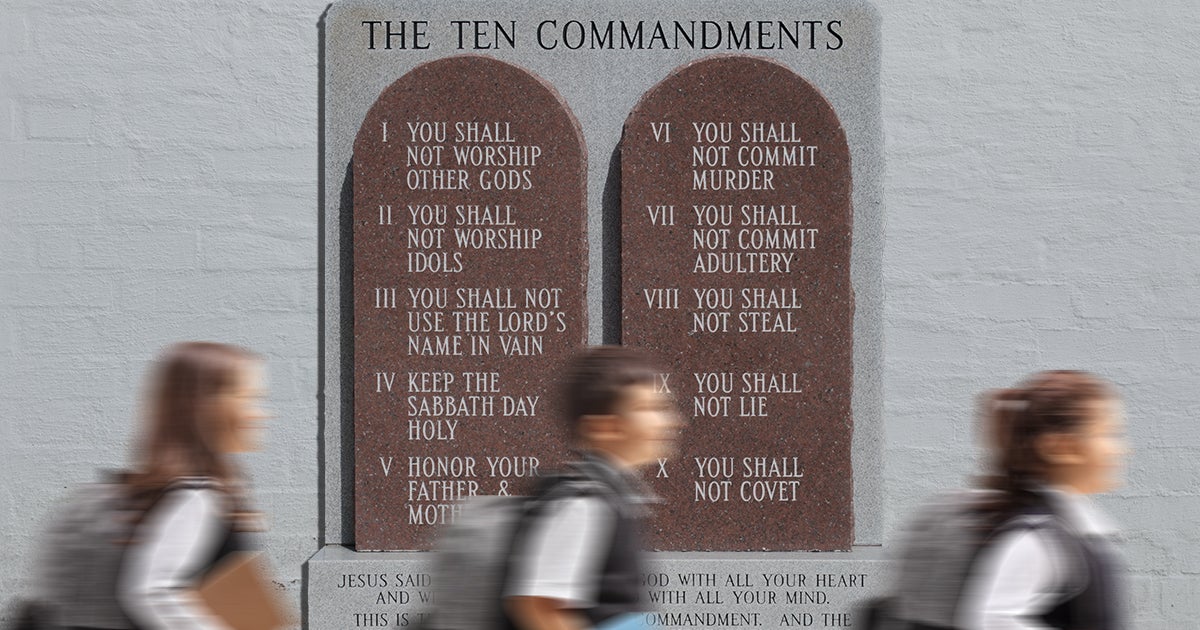
Sacred Texts on Public Walls: Can Louisiana Rewrite the Rules of Church and State?

Ten Commandments | First Liberty Institute

In 2025, Louisiana enacted House Bill 71, a statute requiring that every public school and public university classroom display a state-approved version of the Ten Commandments. The law specifies the text that must be posted and requires that it be accompanied by a statement describing the Commandments’ historical significance in the development of Western legal systems. Almost immediately after its passing, parents and civil liberties organizations filed suit in federal court, arguing that the mandate violates the Establishment Clause of the First Amendment. Although a federal district court initially prohibited the law, the United States Court of Appeals for the Fifth Circuit later lifted that injunction while rehearing the case, allowing the displays to proceed as litigation continues. The Supreme Court has not yet addressed the merits, leaving the constitutional question unresolved.

The controversy centers on a familiar but persistently difficult issue: whether the government may require the display of a religious text in public school classrooms. Louisiana lawmakers defend the statute as an educational measure. In their view, the Ten Commandments are presented not as theological instruction but as a historical source that influenced Anglo-American legal traditions. The state contends that acknowledging this influence does not amount to religious endorsement. Plaintiffs, however, argue that the law compels the state to place a sacred text, one that begins with commands regarding the worship of a particular deity, at the center of the public classroom. In their view, that mandate crosses the constitutional boundary separating church and state.

The most relevant precedent is Stone v. Graham. In Stone, the Supreme Court invalidated a Kentucky statute requiring the posting of the Ten Commandments in public school classrooms. Applying the Establishment Clause framework then in use, the Court concluded that the statute lacked a genuine secular purpose. The classroom setting was pivotal to the Court’s reasoning. Because students are compelled to attend school and are particularly impressionable, the government must avoid actions that appear to endorse religious doctrine. The Louisiana statute closely resembles the law struck down in Stone, and it is difficult to ignore that similarity. Supporters of the new measure appear to anticipate judicial reconsideration of that precedent.

Other Supreme Court decisions, however, complicate the analysis. In 2005, the Court decided two cases involving public displays of the Ten Commandments that produced different outcomes, McCreary County v. ACLU of Kentucky and Van Orden v. Perry. In McCreary County, the Court struck down framed Ten Commandments displays in county courthouses, emphasizing that the displays’ history and presentation suggested a predominantly religious purpose. By contrast, in Van Orden, the Court upheld a Ten Commandments monument on the Texas State Capitol grounds, noting its placement among numerous historical markers and its longstanding presence. These decisions suggest that context and purpose are critical in determining whether a display constitutes impermissible endorsement.

Yet the classroom context remains distinctive. Unlike a monument on capitol grounds, which citizens may choose to approach or ignore, a classroom is a mandatory environment. Students do not enter it voluntarily, nor can they easily avoid exposure to what is displayed there. The power dynamics inherent in public education, where the state sets the curriculum and teachers exercise authority, heighten concerns about governmental endorsement. Even if the legislature characterizes the posting requirement as historical, the content of the Ten Commandments is candidly religious. Several of the commandments concern duties owed directly to God rather than civic norms. That theological dimension distinguishes the text from secular historical documents.

Supporters of the Louisiana law may argue that modern Establishment Clause doctrine has shifted away from rigid tests and toward an emphasis on historical practices and understandings. They might contend that references to the Ten Commandments appear throughout American public life and that excluding them from classrooms reflects hostility toward religion rather than neutrality. In recent years, the Supreme Court has indeed shown greater willingness to accommodate religious expression in public settings. However, there remains an important distinction between accommodating private religious expression and mandating state-sponsored religious display. The Free Exercise Clause protects individuals’ rights to practice their faith without government interference. It does not necessarily authorize the government itself to promote a sacred text in a required educational setting. If constitutional neutrality means that the state neither favors nor disfavors religion, then requiring the display of a specific religious code in every classroom risks signaling preference.

In my opinion, Louisiana’s law is unconstitutional because it conflicts with the purpose of the Establishment Clause. Even if lawmakers describe the postings as correlated to history, the Ten Commandments are not just a historical document. They are a sacred religious text that begins with commands about worshipping one God and rejecting other gods. Requiring that text to be displayed in every public classroom does more than acknowledge religion’s influence, it sends a message that the state is endorsing it. And because the law applies to every public school classroom in Louisiana, that message is not subtle. This is not a small plaque in a museum or a monument surrounded by other historical symbols, it is something students will see every day in a place they are required by law to attend. When the state requires a religious text to hang on the wall, it inevitably carries the impression of government approval. For students who practice different religions, or who are not religious at all, that display can reasonably feel like a signal that the state favors one tradition over others. That is exactly the concern the Supreme Court raised in Stone v. Graham, and those concerns still make sense today. Teaching about religion’s historical influence is one thing, mandating the display of a sacred religious code in every classroom is another.

https://www.reuters.com/legal/government/court-allows-louisiana-law-requiring-ten-commandments-schools-take-effect-2026-02-20/

https://lailluminator.com/2026/02/20/louisiana-ten-commandments-4/

https://www.oyez.org/cases/1980/80-321

https://www.oyez.org/cases/2004/03-1693

https://www.oyez.org/cases/2004/03-1500


Friday, February 20, 2026

Rastafarian Man Demands Reprucussions for a Violation of His Nazarite Vow

    On December 28, 2020, Damon Landor was transferred to the Raymond Laborde Correctional Center (RLCC) to serve the last three weeks of his five-month sentence. Landor was a practicing Rastafarian and had taken the Nazarite vow, which, among other things, prohibited him from cutting his hair; a ritual he upheld for over two decades. Because of his beliefs, Landor had been permitted to keep his long dreadlocks at the other two correctional facilities he had been held in prior to the RLCC. However, upon his arrival at the RLCC, Landor, preemptively providing documents that should have permitted him to keep his dreadlocks as they had at the other two facilities, was shackled and his head shaved. The prison officials ignored his arguments that their actions were a violation of his First Amendment right to Free Exercise of Religion, even claiming judicial precedence, and proceeded to forcibly shave his head. 

    Upon his release, Landor immediately filed a lawsuit against the Louisiana Department of Corrections and Public Safety, its Secretary James LeBlanc, the correctional center, and Warden Marcus Myers on grounds that his rights granted by the Religious Land Use and Institutionalized Persons Act (RLUIPA) had been violated. Additionally, Landor claimed that there was judicial precedence from a case brought before the Fifth Circuit Court in 2017. The case in question, Ware v. Louisiana Department of Correctionswas a case almost identical to Landor’s. In this case, Christopher Ware, just like Landor, was a Rastafarian who had taken the Nazarite vow and had dreadlocks at the time of his incarceration. Unlike Landor, however, Ware was permitted to keep his dreadlocks because the Louisiana DOC “failed to satisfy its burden to show the policies are the least restrictive means of serving a compelling interest.” Therefore, Ware was permitted to uphold his vow throughout his incarceration. Given the result of this case, Landor argued before the cutting of his hair that he should be able to practice his beliefs and that the RLUIPA protected his practices. As it has been mentioned, the prison officials disregarded these arguments and presentations of evidence and proceeded to cut his hair. In doing so, Landor has claimed his liberties were breached and is in fact pursuing a recovery of monetary damages. However, when Landor’s case reached the Fifth Circuit Court, as did Ware’s, the court overruled his plea and stated that the RLUIPA did allow for monetary damages to be recovered from the prison officials who had violated his rights. 

    While, admittedly, the primary question before the Court is whether the RLUIPA allows monetary damages to be recovered from individual officials, it is important to note that what we are discussing is whether Landor’s religious liberties were violated by the prison officials. While Landor believes that they have been, an argument could be made that the prison officials were in fact attempting ensure the greater peace and good order of the facility. I believe that it is safe to say that the prison officials believed that they were adhering to Department of Corrections grooming guidelines and, therefore, that they were recognizing and enforcing a compelling state interest in the matter. While the Ware case had in some ways rewritten grooming policies (which should have protected Landor), there was still a loose guideline that required inmates to have short hair (no dreadlocks) and typically required a buzz cut upon entry into federal correctional facilities. It is argued and understood that these policies were established to preserve the greater peace and good order of the facility, and if put up to the Sherbert Test would regularly be recognized as the compelling state interest in most matters involving the free exercise of religion.  In this situation, it is clear to see that the officials deemed Landor’s actions to be a threat to this peace and good order; it just becomes a question of whether or not they were applying restrictions in the least restrictive manner as instituted by the Sherbert Test.

    While this case, unlike many regarding free exercise of religion, has a semi-clear answer when it comes to the question of whether religious rights were violated, it is still valuable to realize the complexity of compelling state interests and claims of religious rights violations. While the true question before the Court is concerning whether the Fifth Circuit Court of Appeals was correct in its ruling that the RLUIPA does not allow for monetary damages to be recovered from these prison officials, that to me is not the primary question we need to be discussing. I believe that even though it is highly likely that the Supreme Court will rule that Landor’s appeal is unconstitutional, it disregards the fact that Landor’s rights to uphold the Rastafarian Nazarite vow were violated in this sense. If the question before the Court was whether or not the officials violated Landor’s religious liberties, I think the outcome would be very different. 


https://www.oyez.org/cases/2025/23-1197

https://www.washingtonpost.com/politics/2025/06/23/supreme-court-louisiana-prison-guards-rastafarian-dreadlocks/


Public Funds and Private Faith: Oklahoma Funding For A Jewish Charter School

   On February 9th, the Oklahoma Statewide Charter School Board (SCSB) unanimously rejected a proposal by the Ben Gamla Jewish Charter School Foundation to open a virtual Jewish charter school within the state of Oklahoma. The school was projected to open in the fall of 2026, with 500 students and state funding of $2.6 million, estimated to grow to 1,500 students and funding of $8.3 million by 2030. Oklahoma is home to roughly 9,000 Jews, which is less than 1% of the state population. This small statewide presence has fueled skepticism among some Jewish leaders, who have questioned the need for the charter in the first place. 

    The application has been advanced by Peter Deutsch, a former congressman from Florida, who opened the first Ben Gamla charter school in Florida in 2007. The school operates as "Hebrew language and Jewish culture-themed", allowing students to be released during the school day for religious education. There are currently six active Ben Gamla charter schools in South Florida. Deutsch supported the Oklahoma application by noting that "The schools have consistently performed and been rated at the top 5 or 10% of public schools, not just charter schools, in the state of Florida", claiming that "The opportunity is probably the best in Oklahoma of any state". 

    The OSCSB's rejection derives from the legal precedent established by the Oklahoma Supreme Court in 2024, which held that religious charter schools are unlawful under the state's Constitution. The ruling arose when the Statewide Virtual Charter School Board approved a proposed virtual charter school by the Roman Catholic Archdiocese of Oklahoma City and Diocese of Tulsa. Oklahoma Attorney General Gentner Drummon sued the SVCSB, declaring the proposal to be in violation of state laws preventing establishment of religion. The Oklahoma Supreme Court then sided with Drummond, causing the SCSB to appeal to the U.S. Supreme Court. The board argued that the state's rejection of religious, publicly funded charter schools, solely because of their religious status, is exclusionary in nature. On May 22, 2025, the U.S. The Supreme Court issued a 4-4 split decision with one justice recusing, leading to an equally divided court. With this, the Supreme Court of Oklahoma's decision was affirmed by the split decision, and the proposal of the virtual Catholic school was rejected. 

A week before the unanimous decision, Americans United, the ACLU, the Education Law Center, and the Freedom From Religion Foundation authored a note that urged the SCSB to reject the Ben Gamla application. The letter circulates around the idea that while explicit religious education would occur off-campus during administered breaks, the school would still operate with religious purpose. This is inconsistent with the legal definition of a public charter school, which must be secular and open to all students, regardless of religion. The school would also create religious discrimination in admissions and hiring, which is contrary to law that requires public charter schools to be open to all students and staff. The letter additionally referenced the Oklahoma Statewide Charter School Board v. Drummond case to support their argument. With this, the Constitution’s Establishment Clause is clearly violated as the state endorses religious education and discriminates against the public. 

SCSB Chairman Brian Shellem spoke on the matter following the board’s decision, saying that he welcomes further action from the Legislature and Ben Gamla. He also notably added that he hopes the matter makes its way back to the Supreme Court following the lack of consensus that Drummond provided. 

The situation between the SCSB and Ben Gamla poses questions and implications regarding the Establishment and Free Exercise Clauses of the First Amendment. While the proposal was rejected, the operation of Ben Gamla schools in South Florida, as well as the split decision in Drummond clearly display that there are unresolved issues. This poses the question: Can a state operate a religious, public charter school without violating the Establishment Clause? If it refuses, is that a violation of the Free Exercise Clause?

This situation obviously directly relates to Drummond, but also to cases such as Espinoza v. Montana Department of Revenue. In Espinoza, the state of Montana created a tax-credit scholarship program that aided families in paying for private school tuition. The court struck the program down because the funds were being used at religious schools, leading parents to sue. This brought the issue to the Supreme Court, with the ruling being 5-4 in favor of the parents. The majority argued that once the state had created the public aid program, they could not exclude religious schools as doing so would be in violation of the Free Exercise Clause.

In my opinion, the proposal of the publicly-funded Ben Gamla Jewish Charter School should remain rejected, as accepting the proposal would be in violation of the Establishment clause. A substantial aspect of this case is weighing the Free Exercise and Establishment Clauses to determine which one is being violated. Espinoza is different because the public aid program provides neutral funds that can be used in whatever way the recipients choose to. The state of Montana does not endorse or establish religion by providing aid that can be used for the education of children in religious or secular schools. This situation is different because the school is directly funded by taxpayers. Students are given a designated period to leave campus to engage in explicit religious education, which is Constitutional as established in Zorach v. Clauson. Despite this, the school operates with religious purpose and instruction that while not explicitly taught on-campus, creates an environment of coercion for students that endorses the Jewish faith. Acceptance of the proposal would create long-term implications, as the creation of a publicly-funded Jewish school would mean that the state must accept proposals of all denominations. This would lead to public education being denominational, which clearly violates the Establishment Clause. Overall, the SCSB’s rejection of the Ben Gamla school upholds the Establishment Clause by refusing to endorse the Jewish faith through public funds, which is not exclusive.

Investigating Faith: First Choice Women's Resource Centers v. Platkin

The ongoing Supreme Court case First Choice Women’s Resource Centers v. Platkin presents crucial questions about religious protections and the state government’s right to investigate faith-based organizations. 


First Choice Women’s Resource Centers, shorthandedly known as First Choice, is a New Jersey-based nonprofit organization that began in 1985. First Choice provides pregnancy-related services to women in need, including but not limited to counseling, ultrasounds, and material items like diapers and baby clothes. The organization openly identifies as pro-life and faith-based, with its employees taking a vow of faith alongside close collaboration with ministry partners at churches.

In November 2023, New Jersey Attorney General Matthew Platkin issued a “sweeping subpoena” to First Choice. Essentially, a sweeping subpoena is an extensive legal demand for documents and data to investigate what the state government deems a “large-scale” issue. The compelling state interest of New Jersey’s Division of Consumer Affairs was in investigating concerns that First Choice’s public websites may have omitted important information to mislead clients and donors about its services, staff qualifications, and medical credibility. In particular, the state was interested in investigating First Choice’s claims regarding abortion pill reversal (APR) and questions of whether unlicensed individuals were providing services that required credentials. 

The subpoena ordered by Platkin required First Choice to present ten-year’s worth of documents, including internal, private communications, advertising materials, donor information, and communications with partner ministries and organizations. However, First Choice firmly objected to the subpoena, especially to the release of donor information, claiming that it violated their First Amendment right to Free Exercise of their religious practices. 

The litigation in this case soon became complicated. In state court, a judge ruled to end the subpoena, instead encouraging both sides to renegotiate the scope of the Division of Community Affairs’s investigation. Simultaneously, First Choice filed a federal lawsuit to prevent enforcement of the subpoena on the grounds that it violated their constitutional rights. However, both the federal district court and the Third Court of Appeals dismissed the case, labeling it as “unripe”. This label means that the Court did not see a need for legal intervention, as there was not yet a renegotiated demand for compliance. Yet, the Supreme Court agreed to First Choice’s request to hear their case on June 16, 2025, and it was argued on December 2 of the same year.

The Platkin case raises a core constitutional issue: 

Does the New Jersey Attorney General’s subpoena to First Choice, a nonprofit, faith-based pregnancy center, violate the organization’s First Amendment right of Free Exercise by forcing them into Court over their religious beliefs?

In past cases, the Supreme Court has historically recognized that religious institutions’s internal decision-making must be constitutionally protected. For example, in Hosanna-Tabor Evangelical Lutheran Church v. EEOC (2012), the Court ruled that the government cannot interfere with a religious organization’s minister selection, as doing so infiltrates their Free Exercise rights. Similarly, in Our Lady of Guadalupe School v. Morrissey-Berru (2020), the Court ruled that civil authorities are not able to question judgments that are important to a religious organization’s identity. Essentially, both of these cases established a precedent that the First Amendment’s Free Exercise Clause protects religious organizations’ autonomy over their mission activities, without state interference.

This case is important because it conveys how Free Exercise debates are centered around real, human lives, beyond the traditional settings frequently discussed by the Court, such as schools, churches, or workplaces. First Choice was created to assist women in vulnerable, often isolating situations as a faith-based organization seeking to do good in the public sphere. If Free Exercise protections are not made generally available, then organizations like First Choice may find their core missions subject to state control and monitoring. How the Court rules in Platkin will determine whether these protections extend to lived religious services. 

In my opinion, this case is more complex than merely deciding whether First Choice should be exempt from state investigations. The state of New Jersey does have a legitimate compelling interest in protecting consumers from misleading information and questionable medical credibility, concerns that should not be ignored because an organization is faith-based. However, simultaneously, the broad scope of Platkin’s subpoena raises constitutional concerns. Requesting several years’ worth of communications and private donor data risks extending beyond neutral oversight and into the internal functioning of the organization. The Free Exercise Clause should not allow faith-based organizations to be exempt from safety regulations, but it also cannot be so restricted that it allows the government to inappropriately investigate how those organizations define and carry out their missions. 

Given this layered perspective, as well as the precedents set in both EEOC and Morrissey-Berru, I think that the Supreme Court is likely to rule in favor of First Choice. The Court has recently shown a willingness to protect religious organizations from government overstepping into internal religious processes. However, while I do think the Court will find Platkin’s subpoena a government intrusion, I do not think that they will disregard the state’s right to investigate specific, reasonably-questionable concerns within religious organizations. A ruling of this sort would uphold First Choice’s First Amendment Free Exercise protections while resisting an absolute exemption from the compelling interest of consumer protections. 


Sources:

https://becketfund.org/case/first-choice-womens-resource-centers-v-platkin/

https://www.oyez.org/cases/2025/24-781

https://www.scotusblog.com/cases/case-files/first-choice-womens-resource-centers-inc-v-platkin/

https://www.oyez.org/cases/2011/10-553

https://www.oyez.org/cases/2019/19-267