Sunday, February 27, 2022

Alive Church of the Nazarene, Inc. v. Prince William County, Virginia

In August 2021, Alive Church (located in Prince William County, Virginia) filed a lawsuit against Prince William County for violating their religious freedoms and rights. The church agreed to be zoned as an “agritourism” facility when they stopped holding services at a public school. This was because they did not have the funding, and thus had to hold gatherings at this new property. The congregation chose to grow fruit trees, as well as make non-alcoholic apple cider in order to abide by the fact that they must be using the land for agricultural purposes. The church chose to be zoned as an agritourism property to avoid hundreds of thousands of dollars in changes to the property that the county would have required to be zoned differently. It is important to note that the zoning administrator approved the church as an agritourism facility. However, the administrator said that the church must acquire a liquor license to hold gatherings on the property. Alive Church does not promote alcohol, so they declined obtaining the liquor license. According to Virginia law, agritourism does not require alcohol sales. The suit is that the county is allegedly violating the religious freedoms and beliefs of the church under the Religious Land Use and Institutionalized Persons Act. The congregation was banned from holding services on the property unless they obtained a liquor license. This is a violation of the church’s religion, which therefore violates their right to free exercise of religion. The county wanted them to obtain a liquor license, however the church does not even use real wine in their Communion events, as well as the fact that they do not serve any other type of alcohol. The church argued that it was being discriminated against compared to farm wineries and breweries, both of which were allowed to hold events and meetings on A-1 (agricultural zoning district) Property. The outcome of the case was that the court rejected the church’s RLUIPA, Free Exercise, Freedom of Assembly, and Equal Protection challenges. However, the ACLJ filed an appeal to the Fourth Circuit Court of Appeals last week to challenge the original decision. 

The main question of this case is: Is Prince William County violating Alive Church’s free exercise of religion by requiring the congregation to obtain a liquor license since they are on A-1 Property, even though they do not participate in activities involving alcohol? The answer decided by the court was no, however there are multiple angles one can take to interpreting this case. To begin, the fact that the church used to worship in a public school and moved to this property, one that that involves agritourism, automatically brings a few things into question. Did the church just grow fruit trees and make non-alcoholic apple cider to be able to worship on this land? Most would assume the answer is yes, but because they were not financially stable enough to worship somewhere else. This point in itself questions the sincerity of the church with regard to growing those goods. 

The church feels that their rights are being violated because their religion does not encourage alcohol. However, since it is an A-1 Property, the point comes into question, is this discrimination occurring just because they are a church? 

I believe there are a few religion and constitutional law topics examined and involved in the case. There is certainly a compelling state interest that can be argued. Some may think that the church should require a liquor license, because the property they are on technically requires it, regardless of the organization. However, since the congregation does not participate in the activities regarding alcohol, I do not see how this would be a problem that negatively affects other people. If people are not consuming alcohol, I do not think the church should have to obtain a liquor license, and therefore think it is a violation of their free exercise of religion. 

Moreover, there is a slippery slope present here. If the church would have obtained the liquor license, this would set the precedent that all other organizations that are established and worship on A-1 Property must obtain a license, even if they do not consume, promote, or sell alcohol. Who do you allow to hold gatherings on this land, and do their religious beliefs matter? The issue lies within the fact that the church does not support alcohol, therefore why should they have to get a license to be able to have it? 

I believe that the rights of the church are being violated by the county requiring them to obtain a liquor license since they worship on “agritourism” grounds. I think their gatherings are harmless, and do not involve alcohol. On the other hand, I do understand that it is tricky because the congregation decided to plant fruit trees and make non-alcoholic apple cider to comply with the A-1 Property requirements. Some people may question what the true meaning behind the trees being planted is, which tests sincerity. I do not think sincerity is threatening or harmful enough in this situation to force the church to get a liquor license. Yes, the land is supposed to be used for agricultural purposes, but the church technically has an agricultural purpose present here. They do not support alcohol, so therefore why should they be forced to obtain the license? I agree with the recent appeal by the ACLJ, since I did not agree with the court’s original decision that the rights of Alive Church were not violated. 

Sources:

Friday, February 25, 2022

303 Creative LLC v. Elenis


    Lorie Smith is an aspiring web designer in Colorado. Prior to starting her business, she filed against the state’s anti-discrimination laws that forbid discrimination against same-sex couples. However, given her religious beliefs, Smith feels that by providing her services to same-sex couples, her actions would conflict with God’s will. Smith has proposed posting a message on her website stating that the company will not create wedding websites for LGBTQ+ customers, due to religious beliefs.
The lawsuit was filed against the state because Colorado law prevents discrimination from occurring at businesses that are open to the public. The Colorado Anti-Discrimination Act “makes it illegal for someone to withhold services based on another person’s race, sexual orientation, disability, or national origin, among other characteristics.” Additionally, statements that promote discrimination are forbidden. Before actively breaking the law, Smith decided to file a case, on the grounds that the law violates her First Amendment rights of free speech and free exercise of religion. 


    This case, 303 Creative LLC v. Elenis, has previously made it to the 10th Circuit Court of Appeals in Denver, and will be heard by the Supreme Court during its next term, which is set to start in October. At the Appeals Court level, a 2-1 decision sided with the state, as “Colorado has a compelling interest in protecting both the dignity interests of members of marginalized groups and their material interests in accessing the commercial marketplace.” The Colorado Anti-Discrimination Act was upheld as constitutional because of the understanding that without the protection of such a law, LGBTQ+ individuals would receive services of inferior quality.
    Smith is being represented by the Alliance Defending Freedom, whose claim rests on the argument that the anti-discrimination law in Colorado violates her First Amendment rights, specifically free speech and free exercise of religion. The claim is that Colorado is using their law to silence beliefs with which they do not agree. By mandating that Smith works with same-sex clients, the state forces her to violate her religious beliefs.
    On behalf of the state, Colorado’s attorney general does not feel that there is a concrete issue for which the Supreme Court can decide. Smith has not yet entered business nor has any same-sex couple asked her to create a wedding website, and as a result, Colorado has not yet moved to enforce the law. However, the state feels their law is constitutional given the compelling state interest to protect the rights of marginalized groups in the public economic market.
    The main precedent that individuals are looking to in this case is one that the Supreme Court decided in 2018. This involves a baker, also from Colorado, who refused to create cakes for same-sex weddings because it violated his religious beliefs. In Masterpiece Cakeshop, Ltd. v. Colorado Civil Rights Commission, it was decided 7-2 on behalf of the baker. However, many justices on the court ruled in this case on different grounds, through several concurring opinions. Ultimately it was decided that while the LGBTQ+ community is protected from discrimination, religious beliefs are also protected constitutionally. One key difference in the case is that at the time the refusal to bake a cake occurred, in 2012, some key cases regarding gay marriage had not yet been decided. As a result, the baker was at the time acting in a way he saw as constitutional. However, Smith’s refusal occurred after these critical decisions.
    Ultimately, the key question in this case surrounds whether enforcing an anti-discrimination law, which results in artists having to speak and act in ways that contradict religious beliefs, violates the free speech and freedom of religion clauses of the First Amendment. When considering the facts of the case, I think Smith is likely to win. This is because she receives no state funding of any sort, and ultimately is entitled to both free speech and freedom of religion. Although anti-discrimination laws are in place, I do not think the compelling state interest is strong enough in this case to justify violating the freedom of religion clause. Same sex couples are not guaranteed to have someone work with them, nor is anyone. While violence and hateful acts should not occur, refusing to make a website for a couple because of religious beliefs does not necessarily hurt someone directly. They may be inconvenienced because of the refusal, but they do not face a significant burden since there are likely others willing to make a website for them. Although it might not be of the same caliber, they are not guaranteed the right to work specifically with Smith. Furthermore, Smith seeks to act through a post on her website stating that creating websites for same-sex couples violates her religious beliefs, which is arguably a non-violent way to make this message known. Finally, she is not refusing to work with LGBTQ+ individuals all together, but instead not partaking in wedding planning for them given her religious beliefs.
    The counter argument, siding with the state, would be on the basis that the law is constitutional, and precedent has urged the importance of preserving the rights of same-sex couples. This is seen in Obergefell v. Hodges and United States v. Windsor, both concerning the fundamental right to marry, inclusive of same-sex couples. Similarly, the desire to protect marginalized groups is important, and serves as a compelling state interest to violate the freedom of religion clause in the First Amendment.
    Considering all the facts of the case, I do not think the Colorado anti-discrimination laws themselves are unconstitutional. However, as the court has previously established, both anti-discrimination and freedom of religion are protected constitutionally. Therefore, the situation becomes increasingly difficult. In the end, I think that if the claim is on religious grounds, like Smith’s is, the freedom of religion dominates in this case. If however an artist discriminated against a client based on other claims, the law would be upheld and the artist would be punished. Similarly, if the artist created direct harm against someone, the compelling state interest would out way the freedom of religion.

Sources:


Mays v. Cabell County Board of Education

  On February 2, two homeroom teachers at Huntington High School in West Virginia brought their class to an Evangelical Christian revival at the school.  The teachers brought their entire class and required that students attended.  The principal and assistant principal were present at the assembly. At the event students were told to close their eyes, raise their hands and pray.  They were also asked to turn their lives over to Jesus and to find purpose in salvation.  The leaders of the prayer also told the students that if they did not follow the Bible they would go to “face eternal damnation”.  Finally, students were encouraged to attend a nearby church where they had the opportunity to be baptized. One student who attended the event, who was Jewish, asked to leave and was told that he was required to stay.  The group who held the event, Nik Walker Ministries, held a similar event at Huntington East Middle School the day before.  Last week, students held a walk out, in which one hundred students took part, protesting that the assembly violated the separation of church and state.  Jedd Flowers, a spokesperson for the Cabell County Schools, told the Associated Press that the assembly was supposed to be voluntary, but two teachers made an honest mistake.  

A group of about a dozen parents, with the help of the Freedom From Religion Foundation, are suing the Cabell County Board of Education, its superintendent, and Huntington High School principal Daniel Gleason.  The suit claims that allowing the event to happen during the school day violates the Establishment Clause of the First Amendment.  The plaintiffs are seeking for the district to be barred from sponsoring any religious events, having any adult-led religious events during the school day, or participating in any religious events with the students during the school day.  

The constitutional issue that is at contention here is if the teachers requiring their students to attend a religious event during the school day violates the Establishment Clause of the First Amendment.  Further, the Freedom From Religious Foundation argues that the issue is that the school would even hold a religious event on school grounds during the school day.  The students also argue that the event is a violation of the separation of church and state.  

There are multiple cases that deal with the issue of prayer taking place in public schools and whether requiring students to attend such events is a violation of the Establishment Clause.  In Abington Township v. Schempp, the Supreme Court ruled that public schools could not sponsor Bible readings or recitations under the Establishment Clause.  McCollum v. Board of Education looked at a program in Illinois in which students had “released time” where they left class and took part in religious events on school grounds.  The Supreme Court went further on their ruling in Abington Township v. Schempp, ruling that it was unconstitutional to use school property for religious purposes.  Finally, in Engel v. Vitale, the Supreme Court further upheld their previous rulings on prayer in schools ruling that the state can not hold prayer in public schools, even if attendance is not required.  

I believe that the result of this case is that Huntington High School violated the Establishment Clause of the First Amendment.  The parents initially argued that the fact that students were required to attend the prayer was the constitutional issue, but I would go further to say that just holding the prayer at all is a clear violation of the students constitutional rights.  Previous rulings have made it clear that public schools are not allowed, under the Constitution, to hold any prayers that take place on public school property.  In this case, the public school did not only hold the prayer on school grounds, but teachers requiring their students to attend is a clear attempt to establish a religion through public means.  Students were asked to participate in prayer and told if they did not accept Jesus, they would “face eternal damnation”.  This is a very transparent effort by the teachers to establish and promote religion.  Students were also coerced into attending, which has been determined to be a violation of students’ constitutional rights.  There is also a clear violation of the separation of church and state.  Holding a religious event on school property creates too much entanglement between church and state and is a clear constitutional violation.  Based on all of these facts, as well as rulings in previous Supreme Court cases involving similar situations, I believe that the court should rule this a violation of the Establishment Clause and disallow the school to hold any future religious events such as the assembly that took place.  


Sources:

https://www.npr.org/2022/02/18/1081678752/west-virginia-school-christian-assembly-lawsuit

https://ffrf.org/news/news-releases/item/40508-breaking-ffrf-with-students-parents-sues-huntington-w-va-schools-over-christian-revival

https://www.wfxrtv.com/news/regional-news/west-virginia-news/lawsuit-filed-against-cabell-county-schools/


Monday, February 21, 2022

From Helpful to Hurtful: COVID-19 Restrictions and Free Exercise (Capitol Hill Baptist Church v. Bowser)

During the beginning months of the COVID-19 pandemic, groups and organizations of all different purposes halted in-person gatherings across the globe to avoid worsening the public health crisis. The mayor of the District of Columbia, Muriel Bowser, announced an order to limit all in-person non-essential business and large gatherings on March 24, 2020, to go into effect the following day. The Capitol Hill Baptist Church, located in Washington, D.C., voluntarily canceled in-person services prior to this order, on March 15, 2020. They wanted to take precautions to protect their congregation and surrounding communities as soon as possible, prior to the rapid spread of COVID-19 in the United States. 

    The Capitol Hill Baptist Church was established 142 years ago and, until the COVID-19 pandemic, religious services were only stopped once for three weeks during the Spanish Flu pandemic in 1918. In June of 2020, three months after stopping services, the Capitol Hill Baptist Church filed for a waiver of the mayor’s order to resume their services outdoors, with policies to wear masks and socially distance, yet they never received a response. 

    After 42 states lifted restrictions on large gatherings, including religious services, the Capitol Hill Baptist Church filed for another waiver in September of 2020, and despite D.C.’s position as an outlier with their remaining restrictions, the request was denied. At this time, D.C. was in Phase Two of lifting their restrictions, opening businesses, and resuming activities; however, the limit for outdoor religious worship was 100 people. During this time, Mayor Bowser not only allowed, but encouraged participation in peaceful protests against racial discrimination and social injustices that accommodated thousands. Both peaceful protests and outdoor religious services fall into the category of “forms of outdoor First Amendment activities”. 

Capitol Hill Baptist Church outdoor worship in compliance with COVID-19 protocols (Washington, D.C. 2020).

    The Capitol Hill Baptist Church filed a lawsuit against Mayor Bowser and the city on September 22, 2020, asking for their constitutional right to free exercise of their religion to be respected in the same way as the protestors’ right to free speech. The Department of Justice filed a statement of interest advocating for the Capitol Hill Baptist Church and urging the federal district court to allow these gatherings because they place a substantial burden on religious exercise. Additionally, this case is a proper case to make this decision because they were not asking for preferential treatment, just treatment that is equal to those of non-religious groups and gatherings.

Furthermore, the difference between the restrictions on these activities poses the question: Is Mayor Bowser’s order limiting in-person, outdoor religious worship a violation of the First Amendment’s Free Exercise Clause and the Religious Freedom Restoration Act (RFRA)? This issue is important because the topic of religious exercise during the pandemic has affected religious organizations across the globe, and the extended timing of restrictions needed a decision to look to for either approval or denial.

In October of 2020, a decision was made in Capitol Hill Baptist Church v. Bowser. Judge McFadden of the U.S. District Court of D.C. ruled that the Capitol Hill Baptist Church can hold outdoor services, despite the mayor’s order because of the substantial burden placed on religious exercise, the allowance of other outdoor First Amendment activities, and the failure to prove a compelling government interest. The Judge protected the free exercise of religion and clarified that the order was a violation of the Free Exercise Clause and the RFRA. This decision was not appealed, and ultimately ended in a settlement to pay the Church’s legal fees and not impose additional restrictions that limit religious exercise.

I agree with the federal district Judge’s decision because of the disparate impact resulting from the order. The order put a substantial burden on religious exercise in D.C., clearly violated the First Amendment rights of religious organizations, and was not neutral between religion and non-religion. Additionally, the Church attempted to solve this amicably prior to filing a lawsuit and did not take legal action until their second request for a waiver was denied. Furthermore, the RFRA requires proof of compelling government interest and that this option is the least restrictive means to achieve the goal. Although the defense attempted to prove that the compelling government interest is the public health crisis, this is undermined by Mayor Bowser’s approval of large gatherings for protests during the same time that she denied the Church’s request. Additionally, the Church stated that they would continue to follow safety protocols and CDC guidelines while remaining outdoors.

Furthermore, the Capitol Hill Baptist Church’s history of compliance and clear effort to follow safety precautions shows that they were not trying to undermine the government or hold religious services illegally. The fact that a city mayor was able to stop the religious exercise of 850 individuals for months while no longer meeting the burden of proof is evidence that a statement needed to be made that those restrictive actions will not be tolerated. If an unconstitutional order of Mayor Bowser in D.C. is approved on such a public stage, what other unconstitutional orders would city and state officials put into effect? A win for Mayor Bowser now would be a loss for the American people in the future.

Sources:

Capitol Hill Baptist Church v. Bowser (Becket Law)

DOJ Statement of Interest

Update: Capitol Hill Baptist Wins in District Court (ERLC)

Sunday, February 20, 2022

Abraham House of God v. Horn Lake


In November of 2021 a Muslim organization, Abraham House of God, filed plans with the city of Horn Lake, Mississippi for the construction of a new mosque. The proposed mosque would have been the first of its kind in the entire county. The plans submitted are said to have met or exceeded all necessary rules and regulations that the city’s planning commission had laid out regarding construction and site planning. Additionally, the proposed site was going to be built on land that was specifically designated and zoned for houses of worship. However, when the zoning proceedings took place, Horn Lake’s planning commission voted 5-1 to reject the mosque’s site plan and prevent any construction of a mosque. After this decision was made, a city alderman defended the council’s decision and stated that their religion “says they can lie or do anything to the Jews or gentiles because we’re not Muslims.” Another alderman simply revealed that he denied the site plan because they are Muslims.

The lawsuit, brought on behalf of the mosque and its co-founder, brings up the overall question of this case: Did the city violate the Free Exercise Clause of the First Amendment to the U.S. Constitution by rejecting the mosque site for members of the Abraham House of God.

A U.S. district judge recently made an initial ruling regarding this case in January and ordered the City of Horn Lake to grant approval for the site plan and mosque located in the city. The decision also stated the board of alderman must also “consider, process, and act upon -- without any unusual delays and free from and illegal discriminatory intent or affect -- all other applications associated with the construction and operation of the mosque.”


Since this decision, there has yet to be an appeal of further legal action. However, I believe that if the supreme court were to look at this case there would be many additional laws and precedences available to take into consideration when making the right decision. In 2000, congress passed the Religious Land Use and Institutionalized Persons Act. The goal of this was to protect houses of worship and religious institutions from being discriminated against in zoning and landmarking laws. In addition to this, the 14th Amendment states that all individuals, no matter what, must be protected by laws in the same manner. Islamic Society of Basking Ridge v. Bernards is a similar local case in which the Township of Bernards denied the Basking Ridge Muslim congregation the right to build a new mosque. As a result, they went to court and the district court ruled in favor of the mosque's right to build citing both free exercise and the right for all religious groups to be treated equally as their main reasoning.


After analyzing this case, it is clear to me that yes, the city’s actions definitely violated the Free Exercise Clause of the Constitution along with many other laws. The Constitution clearly states that citizens have the right to practice their religion as they please. Building a mosque as a place of worship allows for the Muslim community with Horn Lake and its surrounding area to do so in a sincere way. The development of a mosque, on land that had already been designated for religious use, in no way imposes any form of a substantial burden on the city or the individuals living in it as designated by the Religious Land Use and Institutionalized Persons Act. Not to mention the fact that under the 14th Amendment, all citizens of Horn Lake must be treated and protected in the same manner. I find it hard to believe that if the plans submitted were for a religion that was more common in the area, the ruling of the city aldermen would have been the same. Like the similar cases expressed above, religious minorities are discriminated against too often and laws like the free exercise clause are built to protect them. Thus, we should ensure that it fulfills its purpose.


If the situation was different, and Abraham House of God was asking for government assistance or funds for the building of the mosque, I could see how the action of providing direct aid might not be permissible. An action like this would have the possibility of leading to a slippery slope and other religious groups looking for similar aid. The founders and members of Abraham House of God, on the other hand, are doing no such thing. Instead, they are merely practicing their constitutional rights as both members of a religious community as well as individuals in society. I believe this is a case of true discrimination which has no business being tolerated in any capacity. 


https://www.wjtv.com/news/state/aclu-files-lawsuit-against-city-of-horn-lake-over-proposed-mosque/
https://www.commercialappeal.com/story/news/2022/01/04/city-horn-lake-must-approve-mosque-site

Religious Questions on the Tennis Court: Chung v. WIAA

 Joelle and Joseph Chung are siblings both competing on their high school tennis team. They are members of the Seventh-day Adventist Church in Chehalis, WA and in following their faith, the Chung siblings observe the Sabbath, a day of rest and prayer every week starting at sundown on Friday to sundown on Saturday. 

The Washington Interscholastic Activities Association (WIAA) is the organization under Washington law which regulates high-school sports and organizes the state postseason tennis tournaments. To make it to the state championship match, players must compete in two qualifying tournaments and must certify that they are able to participate in these varying levels of competition with exemptions for illness, injuries, and 'unforeseen events.' 

In 2018, as a junior Joelle won the first match on the path to the state championship, but had to forfeit her spot since the following round of competition fell on the day of the Sabbath. The following year during her senior season in 2019, with the prospect of advancing to the championship scheduled on Friday and Saturday, the Chung family contacted the WIAA months prior to the tournaments asking for a religious exemption. The Chungs specifically asked for the WIAA to move the day of the championship or for Joelle to use an alternate for the conflicting Sabbath-day championship while playing in the qualifying rounds- therefore asking to preemptively withdrawal. The WIAA denied these requests stating that withdrawal due to anticipated conflict with the Sabbath violated their rules and disregarded the fairness to other tennis players. They stated that it allowing a withdrawing on the Sabbath is (1) unfair to the athletes who would could have taken the qualifying position from the withdrawing athlete, and (2) advantage the athlete scheduled to play the withdrawing athlete. Due to the WIAA's denial of Joelle's request for an allowed withdrawal, she could not compete in the qualifying and championship tournaments. In hopes of pushing the WIAA to change its rules prior to Joseph's high school tennis career, the Chung family sued the WIAA citing the First Amendment Free Exercise Clause in early August 2019. 

In response in late August, the Association added a 'religious observance' exemption which allows "a player to withdraw from competition without being penalized." But the rule change does not move the day of the tournament or allow adjustments to the schedule due to religious observances. The Chungs filed for summary judgement of the case, but it was denied and the WIAA's rule stands.

The question of the case is: does the WIAA's failure to accommodate the religious observance of the Sabbath day when organizing its state high school championship tournaments violate the Free Exercise Clause of the First Amendment?

The Chungs argue this is an issue of the Free Exercise Clause since the WIAA is infringing on their right for the Chung siblings to participate in their religious observance of the Sabbath while disallowing them to play in the tennis championship tournaments. The WIAA's connection to the state is direct since the Washington law grants authority to the Association in matters of high school sport administrations. 

I personally believe that the Court was correct in denying summary judgment and siding with the WIAA, since there is not a clear breach of impeding on the Free Exercise Clause. In fact the WIAA is acting with regards to religious neutrality as its scheduling most likely relies on practical policy decisions. Some of the reasons a tournament might be scheduled on a Friday or Saturday could be to minimize student-athletes and coaches time out of class, to make transportation more accessible, or to maximize attendance to the matches. By accommodating the religious exemption and moving the tennis tournaments, it would end its neutrality of religion and also create a more complex burden for the WIAA and is therefore against the Association and Washington's state interests. 

In potential counter of my point by saying that the tournament is not on a Sunday, which is another religious holy day. But the WIAA could argue that Sundays are secular days to hold make-up competitions or serve as a traveling day to return from competition. This notion of Sundays being make-up and travel-back days is largely practiced all over the US. 

Most importantly, Joelle is not entitled to compete in the postseason tournaments, since she is playing tennis as her choice and there is no specific fundamental right determining engagement and participation in interscholastic high school sports. The Free Exercise Clause does not apply in this situation because she is not entitled through a right or a benefit to play in her high school tennis postseason and it does not directly deny her from not participating in her religious practices. This is further pushed since there was an added 'religious observance' policy, where the WIAA successfully created a fair rule that allowed religious exemption for Joelle and fellow student-athletes without burdening the organization and scheduling of the tournament.

The story of the Chung siblings is a small case in the larger picture of religious exemptions, in this case I argue that there is a line where the state (the WIAA in this scenario) can meet the person in the middle by providing a reasonable accommodation to allow them to freely practice their religious beliefs under the Free Exercise Clause, but the state should not go to far to prioritize and burden other people for the actions of the religious. Of course this sentiment does not and will not apply to all cases of religious exemptions, but I believe this case highlights there is a reasonable balance that the state can take on accusations of impending on the Free Exercise Clause. 

Sources:

Does the Prohibition to Aggressively Discipline Your Children Violate Religious Freedom?

Indiana DCS
    Recently, Cherry and Scott Blattert from Springville Indiana filed a lawsuit against the Indian Department of Child Services after the couple was arrested and the DCS removed their children from their care and in 2019.  The couple had 10 children.  The Indiana State Police department states that they had reason to believe that the parents were harming their children as a form of discipline.  There is video evidence of the father, Scott Blattert, hitting him with a belt, elbowing them in the head, and punching him in the face.  Furthermore, after a round of interviews was done with the children, one stated that their parents often used industrial-grade glue sticks to hit them as a punishment.  These were long, heavy, and skinny and inflicted a lot of pain onto the children.  

    The parents believed that they were just in their punishments as they aligned with what the Holy Bible told them, as seen in The Book of Proverbs in the Old Testament.  They stated many verses in which the Bible did so.  They referenced Proverbs 13:24 - "Whoever spares the rod hates their children, but the one who loves their children is careful to discipline them", Proverbs 23:13 - "Do not withhold discipline from a child; if you punish them with the rod, they will not die", Proverbs 29:15 - "A rod and a reprimand impart wisdom, but a child left undisciplined disgraces a mother", and more.  

These are all direct quotes from the Bible that the couple believes endorses their ability to discipline their children using force, as the Bible not only justifies it, but encourages it.  These quotes, as the couple says, is their duty to follow and discipline their children as such.  It is important to know that Scott Blattert has a criminal history related to previous charges of discipling his children including aggravated battery, multiple felony charges, and multiple accounts of domestic battery resulting in the injury of someone under the age of 14.

    In response to the taking of their children and their arrest, the two decided to sue on the grounds that their religious freedom had been violated.  They refer to the Religious Freedom Restoration Act in stating that their kids being taken from them was unconstitutional.  The act, signed in 2015 by the Former Governor of Indian, Mike Pence, "prohibits a governmental entity from substantially burdening a person's exercise of religion unless the governmental entity can demonstrate that the burden is a furtherance of a compelling governmental state interest".  This lawsuit from the Blattert couple seeks declarative and injunctive relief from the Indiana Department of Child Services.  This means that the couple would like to regain sole custody of their children with no restrictions.
Scott and Cherry Blattert
    
The key issues in this case deal with religious freedom and whether or not the state has "compelling interest" and whether or not this was a true "burden" to the couple.  It also deals with whether or not the couple's First Amendment Right to Freedom of Religion was Violated.  I believe that this a difficult case because it also deals with the slippery slope and the care of children.  If we allow this type of discipline, what else will we allow because the Bible says it's okay?  In all cases we must first make sure that children are never being harmed.  With this mindset, my first thought is how can we allow an adults religion be an excuse to harm children?  That child could have completely different religious ideals  from their parents and harm to them should not be collateral for their parents beliefs.  For this reason, I believe that the state has more than enough compelling interest to put the Blattert children into the care of IDCS as these kids should not be harmed due to their parents beliefs.

    Additionally, I believe that asking the parents to discipline their children without aggressive force is not a burden in any respect.  Although those quotes are in fact from the Bible, they are all from a book in the Old Testament entitled "Proverbs".  This title inherently suggests that these sayings are strictly proverbial and most likely metaphorical; not meant to be taken literally.  The state is not taking away the right for parents to discipline their children, they are prohibiting adults from harming children.  This is not a burden to any parent, as they can still instill rules and discipline their children.

    For the reason of this not being a true "burden" and the state having a strong compelling interest of protecting children, I believe that the children should not return to the custody of Scott and Cherry Blattert as this was not a violation of their First Amendment Right to Religious Freedom, nor did it violate the Religious Freedom Restoration Act.

Di Liscia v Austin: The US Navy and Beard Restrictions

In many religions, having facial hair is an important symbol of faith. The Muslim and Orthodox Jewish religions both have spiritual requirements to have a beard. In the case of Di Liscia v Austin, this tradition comes into conflict with a naval order to be clean-shaven. Edmund Di Liscia is a Hassidic Jew and a member of the Navy. When he first joined the Navy, he received a “no-shave” allowment, but on April 14, 2021, he was told that he had to shave and would face punishment if he did not. He requested a temporary restraining order that would prevent the Defense Department from forcing him to shave, giving him time to file this case. A group of Muslim sailors joined Di Liscia as plaintiffs - Dominque Braggs, Mohammed Shoyeb, and Leo Katsareas. Many sailors have received exemptions for medical reasons but there are no accommodations yet for religious beards. According to the Naval rules, having a beard “reduces safe and effective wear and operation of protective equipment.” It may pose a safety risk to the job of the sailors. However, Di Liscia view his beard as an “expression of obedience and fidelity to God.” He considers it a crucial part of his community and spirituality. 

The overarching question here is whether the government, particularly the military, is prohibiting the plaintiffs’ free exercise of religion by requiring them to shave their facial hair. There is a conflict of interest here between the safety of the sailors and their religious convictions, as well as the fact that other exemptions to this rule have been offered. If Di Liscia cannot receive an exemption, he will be subject to penalties, damaging his career. In this case, he is forced to choose between his job and his religion, which is not a choice one should have to make, especially when one is employed by the government. Religious freedom is a right guaranteed to all citizens, and the ability to put into practice strong religious convictions should not be inhibited by the government unless there is a compelling enough interest that such restrictions would be more beneficial than detrimental. 

I believe that Di Liscia and the other plaintiffs should be given religious exemptions to keep their beards. The traditions in the Orthodox Jewish community and Muslim community in regards to facial hair are well-grounded and sincere. Di Liscia feels as if he has a moral, spiritual, and social obligation to maintain his facial hair. Although there can be a slippery slope here, as sincerity is difficult to judge, in this case, it does help prove that an exemption should be permitted. Also, the state is clearly favoring non-religion over religion as they have allowed exemptions for medical reasons among other cases. While there is a distinction here because these medical reasons are more easy to prove, not providing a religious exemption singles out religion and is a form of discrimination. Furthermore, the state must prove a compelling interest in cases of religious freedom. They have to show that the safety risk behind not being fully clean-shaven is significant enough. One of the plaintiffs, Mohammed Shoyeb, argued that he rarely had situations in which he would have to wear the kind of masks with which the Navy is worried facial hair will interfere. When he did, the beard was inconsequential to the working of the mask. Although this is just one plaintiff’s example, it is evidence against a compelling state interest that being clean shaven will benefit the safety of the plaintiffs. 
It is challenging for the court to rule that these plaintiffs should be exempt because they feel as if their beliefs are sincere. Others may start to argue that they should receive exemptions for their religious convictions that seem more phony, but the court cannot discriminate among religions even if the other cases seem ridiculous. Also, safety is incredibly important, especially in a military context, as this can be a life-or-death situation. However, I believe in this case, there are no significant safety discrepancies between the clean-shaven and bearded sailors in the Navy. Contrary to my beliefs, previous Supreme Court decisions may set a precedent for how a court may rule in this one. In the case
Goldman v Weinberger, an Orthodox Jewish soldier was prohibited from wearing his yarmulke, an important Jewish symbol, while on duty and in uniform for the Air Force. The Court ruled that this regulation did not violate the Constitution, as military operations are unlike general civilian rulings and are subject to harsher review. Regardless, on the grounds that Di Liscia v Austin is arguing, I think the court should rule in opposition to what they have previously ruled. The religious convictions held by the plaintiffs that they need to maintain their beards outweighs arguments against them. The plaintiffs are clearly being denied free exercise of religion by being restricted from practicing a crucial tradition in their respective faiths. This is a governmental violation of the first amendment, as well as religious discrimination.

Thursday, February 17, 2022

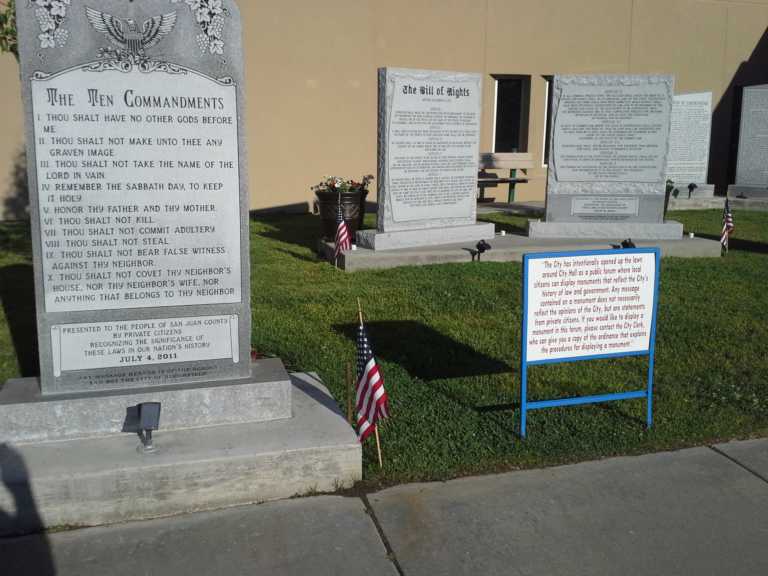
Private Stone, Government Ground: City of Bloomfield v. Felix


In 2007, the city council of Bloomfield, New Mexico wrote out a plan that allowed private citizens to fund certain monuments to be displayed on the City Hall lawn. Kevin Mauzy, a local Bloomfield Councilor, outlined the plan and the Bloomfield council unanimously accepted it. Such monuments included the Declaration of Independence, the Gettysburg Address, the Bill of Rights, and, more controversially, the Ten Commandments. Each monument would have the donors' names on it along with a short description of its significance in American history. This changed five years later, when in 2012, two Bloomfield citizens took offense to the display because of their Wiccan beliefs and sued the city over it. Their argument was that, in displaying the Ten Commandments monument, the Bloomfield government violated the Establishment Clause of the First Amendment.

    The main question at hand is this: Was the privately-funded display of the Ten Commandments monument on government grounds a violation of the Establishment Clause of the First Amendment?

    The federal district court that took the case eventually ruled against the city, with the U.S. Court of Appeals for the 10th Circuit agreeing that the Ten Commandments monument should be taken down. The case was appealed once more, however the Supreme Court declined to look at it, leaving the case at a loss for Bloomfield.

    I believe that if the Supreme Court had looked at this case, there would be many precedences in order to make a constitutionally sound decision. This is not the first time the Ten Commandments had caused controversy, as seen by the cases of McCreary County v. ACLU of Kentucky and Van Orden v. Perry, both decided in the early 2000s. McCreary centered itself on three Kentucky counties in which public schools and courthouses displayed framed copies of the Ten Commandments. The Supreme Court eventually ruled that these copies were unconstitutional because of the intent of these displays, which were to advance religion. This is contrasted in part by Van Orden v. Perry. Van Orden was about a citizen suing a Texas government which had erected a monument of the Ten Commandments on government grounds. However, the Supreme Court ruled that the statue was constitutional because the Commandments were meant to convey a historical meaning rather than a religious one. Therefore, the intent of the religious symbol matters. If the intent in displaying it is to advance religion, then it is unconstitutional. 

    Ergo, Van Orden confirmed that the government may put up potentially religious monuments of historical importance on government property. What about Bloomfield? Through private donations, is this monument constitutionally viable to exist on government ground? To answer this question, I refer back to precedence. The case County of Alleghenty v. ACLU, Greater Pittsburgh Chapter concerned itself with two publicly-funded displays, one Jewish and one Christian. The justices ruled that the Christian display was unconstitutional on government grounds because of the words "Glory to God for the birth of Jesus Christ," on it. Meanwhile, the Jewish display was ruled constitutional because it did not encourage any form of worship. Rather, it was a passive symbol. This case is important because the ruling establishes that forms of religion are allowed on government ground, but only as passive objects. Although the difference in funding is clear, the main role of the monument itself is not.

    With these rulings adjacent to the issue, I believe there is enough to functionally figure out the issue itself. The questions I want to pose are this: while the government's intent is to beautify the city, is the Ten Commandments monument a passive or active object of religion?

    My answer to this question is that if the Supreme Court chose to review this case, they would rule that the intent of this is historical importance, and that this is a passive object of religion, and thus the monument would be allowed to stay up. The Establishment Clause is not being violated because, in this case, the Ten Commandments are being used in a historical context. However, rest of you may reach a different conclusion on this matter. I say this answer because of the inscriptions on the pieces, which reflect the donors' names along with a short paragraph of its significance in American history. If a reasonable onlooker saw this monument among the other well-known documents of the United States, and read the small inscription that told of the historical significance it had, then it would be a natural conclusion for the onlooker to make that these Commandments are there for a historical reason, not a religious one. 

Monday, February 14, 2022

Seattle’s Union Gospel Mission v. Woods

    The Seattle Union Gospel Mission is a religiously based group who helps the homeless by supplying food, shelter, clothing, etc. They are a faith based organization and want all of their employees/volunteers to share the same views. They are now being scrutinized for not hiring a person who did not share the same religion beliefs. The article, Seattle's Union Gospel Mission v. Woods states, "The ministry's religious convictions and evangelization are the foundation for everything it does, and therefore every staff member must share and live out the Mission's religious beliefs for the Mission to be successful." Here the intention is shown that the mission wishes to only higher those who share their belief because they feel that is the message they want to send and share to make their organization effective. 

    The Mission refused to hire a person who did not share the same beliefs as them. They were sued because of this and now they are wanting to be seen by the Supreme Court. They are being defended by Alliance Defending Freedom and Senior Counsel/Vice President of Appellate Advocacy John Bursch states, “As the briefs filed with the Supreme Court rightly argue, churches and religious organizations have the First Amendment right to hire those who share their beliefs without being punished by the government,” He is supporting a non-profit religious organizations right to hire who they wish when it comes to aligning with their religious beliefs. He shows that it is protected under the First Amendment and the government shouldn’t have any bearing on who they can and cannot hire. The first court saw this case and dismissed the lawsuit because they felt as though the non-profit was acting within their rights. Then the Washington Supreme Court decided to take the case. The article states that, “The Washington Supreme Court overrode the exemption and held that the Mission has no First Amendment right to hire only people who share its beliefs.” The Washington Supreme Court is saying that it isn’t right for the Mission to deny a person a job due to their religious affiliation. Whereas, the Alliance Defending Freedom who is representing the Mission says that having the government trying to regulate what religious organizations can and cannot hire based on religion is a violation and they are acting within their First Amendment rights. 

    Looking specifically at the Free Exercise Clause this is an interesting case because they specifically didn’t hire this person due to their religious beliefs, but they should not be required to do so because they are not a government organization. Requiring the Mission to hire a person of another faith could go against their right to free exercise. They have displayed that they wish to help the community through like minded people, so forcing them to hire someone who doesn’t align with their views could be looked at as a violation of their free exercise. They are not a governmental organization so this isn’t an establishment of religion it simply a religious organization choosing to hire people that share their faith. The article goes on to state that, “As a result, Washington law now requires houses of worship and other religious nonprofits to employ those who contradict the beliefs they were created to foster unless a position qualifies for the Washington Supreme Court’s narrow interpretation of a “minister.” The decision threatens to undermine religious nonprofits like the Mission that are organized around and designed to promote a specific, shared set of religious beliefs.” This is a slippery slope because now the government is regulating who religious groups can hire and they are attempting to define what is to be considered a “minister” this could go along with the court case, Cantwell v. Connecticut where a government official had the authority to dictate what should be considered authentic when it comes to sharing your religion or trying to solicit for money. Allowing the government to dictate how private organizations conduct their business is a slippery slope and in the context of religious organizations can be a violation of the free exercise clause. 


Looking at the decision I believe that the Mission should be able to hire who they wish. They are a private organization that is known to have a religious background. I see that the government attempting to regulate who they can hire based on religion is going towards violating their free exercise. I feel like this can go back to the reasoning of you have no right to not be offended. This organization has no obligation to hire a person that they believe does not align with their religious purpose. I can see the view from the other side being that they should not discriminate against someone because of their religion or lack thereof,  but if they are a known religious group and they found another person to hire who aligns with their beliefs instead I think that should be permitted. They are an organization that is looking for specific qualities in a person they are wanting to hire. They want a person to meet their requirements and I do not feel like the government should have any bearing on that when it comes to religious organizations. 

College of the Ozarks v. Biden

On his first day in office, President Joe Biden signed the “Protecting and Combatting Discrimination on the Basis of Gender Identity or Sexual Orientation” directive. This directive aimed to open gendered spaces, such as dorm rooms and bathrooms, to individuals with different sexual orientations. Failure to comply with these new regulations could result in six figure fines, punitive damages, and attorney fees with no religious exemptions. In order to properly implement this directive, the U.S. Department of Housing and Urban Development needed to interpret the meaning of “sex” within the Fair Housing Act of 1968. The Fair Housing Act was created to eliminate housing discrimination based on race, religion, sex, national origin, familial status, or disabilities. As a result, traditionally cisgendered dorm rooms, bathrooms, and other shared spaces were opened to both cisgender and transgender individuals. Alliance Defending Freedom is representing College of the Ozarks, a private Christian college, in the case.

            The essential question here is does the “Protecting and Combatting Discrimination on the Basis of Gender Identity or Sexual Orientation” directive violate College of the Ozarks right to the free exercise of religion? College of the Ozarks argues that the directive forces religious institutions to violate their beliefs and seeks to punish them for their views on marriage and sex. Even though College of the Ozarks is a private institution, they receive federal funds through student loans, grants and contracts and are therefore subject to fair housing laws.

            College of the Ozarks has a reasonable argument here that the directive violates the First Amendment free exercise clause. ADF Senior Counsel Matt Bowman argued that the “College of the Ozarks should be free to follow the religious tradition on which it was founded. The government cannot strip a private, faith-based institution of its constitutionally protected freedoms because it disagrees with its views about marriage and biological sex”[1]. According to College of the Ozarks, the implementation of this directive in their institution would violate their religious beliefs and undermine their religious devotion. Forced compliance threatens the core beliefs of their faith and in turn violates the protections guaranteed to them by the First Amendment. 

            On the other hand, there is a compelling state interest to act and protect individuals from suffering from discrimination based on their gender or sexual orientation. Issues of gender identity and sexual orientation have always been problematic for Catholic institutions. One of the major issues that College of the Ozarks had is with the new interpretation of the meaning of the word "sex" in the Fair Housing Act. The college argues for the traditional meaning referring to ones biological sex and the belief that there are only two sexes. They think this new interpretation changes the historical meaning of the word sex and therefore restricts their right to practice their beliefs within their institution. Typically, I would argue that the government should not be able to require a private religious institution to follow a directive that violates their religious beliefs and duties. However, I feel as though the government can implement this directive because the institution receives federal funds for housing. Even though they are a private institution, they receive federal funds and are therefore able to be held to a standard that may interfere with their religious beliefs. No rights are absolute under the constitution and just because an individual or institution has the right to believe whatever they choose does not give them the right to act in accordance with those beliefs, especially if it begins to violate the rights of others. As seen in other cases, religious freedoms can. Additionally, I think the court should rule against College of the Ozarks because there is a slippery slope issue at hand. If the court allows this institution to have a religious exemption, then where does the line get drawn? 


[1] https://www.cofo.edu/News/moduleId/1421/Id/248/controller/PressRelease/action/details#:~:text=The%20lawsuit%2C%20College%20of%20the,sexual%20orientation%20and%20gender%20identity.