Monday, April 19, 2021

Freedom of Expression and Association in Montana

    The Free Exercise Clause of the First Amendment offers protection for religious individuals and organizations to act without interference from the government. The clause protects various minority religions and ensures that the freedoms of these groups will be protected in courts of law. One area where the application of the Free Exercise Clause is under debate is on public university campuses. 

    Last week, Montana Gov. Greg Gianforte signed two bills that aim to protect individual freedoms on public university campuses in the state. The new law prohibits universities from denying resources to religious, political, or ideological student organizations. This law will even apply to organizations that may hold views that other students find offensive. While potentially offensive organizations can be protected, the Universities, however, can prohibit discrimination targeting particular students. The new law would also ban the limitation of speech to “free speech zones,” which are designated areas on campus that students can share their views on, only after they are approved by University officials. As I discussed in my blog post from February, free speech zone reservations at Universities can sometimes be riddled with various issues, including only granting approval to students speaking about topics Universities agree with.  Under these new bills, individuals who say their free speech is being violated by the university can sue for “damages between $2,000 and $75,000” (US News).

    Opponents of this bill say that, “the measure would allow groups to receive university funding even if they uphold views that exclude or target certain students, such as members of the LGBTQ community” (US News). On Monday April 15th, people gathered at the Montana Capitol steps to express opposition and spread awareness about various bills moving through legislature. While their main focus was not on the University free speech bills, their message was clear with words from Democratic Sen. Bryce Bennett of Missoula, the first openly gay man elected to the Montana Legislature saying, “The folks in the building behind me were hoping they could steal your rights and no one would notice,” (AP News), as well as messages on signs with one reading: “I support the separation of church and hate” (AP News). It is clear that although the protesters were not explicitly protesting against the University bills, they would not support the allowance and opportunity these bills give to religious groups that claim anti-LGBTQ beliefs to be central aspects of their practice.

    When it comes to the bills signed in by the Governor of Montana, the central question is: does the Free Exercise Clause protect allowing religious, political, or ideological student organizations from receiving resources from public universities even if they hold views that other students may view as discriminatory or offensive.

    I agree with the signing of these bills and I do believe that the funding of religious, political, and ideological student organizations should be protected under the Free Exercise Clause of the First Amendment. The first reason I believe these organizations should be funded even if they have potentially offensive beliefs is because I believe there needs to be neutrality towards religion when there is funding for secular organizations. If the bill only allowed student organizations that are not “offensive” to be funded, then there would not be neutrality towards religion. In the case Rosenberger v. Rector and Visitors of the University of Virginia, the Court held in a 5-4 decision that “the University could not stop all funding of religious speech while continuing to fund an atheistic perspective. The exclusion of several views is as offensive to free speech as the exclusion of only one” (Oyez). With this in mind, the Montana bills are important in protecting the funding of all student organizations, including those which are religious.

    A second case that provides reasoning for why the bills should be passed is Christian Legal Society v. Martinez and its dissenting opinion. In this case the Court ruled in a 5-4 decision to support the all-comers policy as a reasonable practice. The Court ruled against what I am arguing, but the decision was a narrow one. The dissent made a strong argument including the comment from Justice Alito where he highlights that the student forum claims to “promote a diversity of viewpoints among registered student organizations, including viewpoints on religion and human sexuality” (564), but without the allowance of groups that only allow members that agree with their policies this is not truly what can happen.  

    In the context of Montana, I believe that these bills are crucial in protecting freedoms on college campuses and they are protected by the Free Exercise Clause of the First Amendment. I believe that on college campuses there should be equal funding for student organizations, even if some of the organizations have inspired beliefs that are seen as offensive to other people. For many religions there are beliefs that are extremely important to them but are offensive to others. I do not think that having offensive viewpoints means openly discriminating to people, and the bills put forth by the Governor acknowledge the Universities right to prohibit discrimination towards individual students. I think college campuses are a place where a diversity of viewpoints should be encouraged as they are areas for students to explore different ideas that they have not had exposure to in their lives. As seen in the two differing Court opinions highlighted earlier, this topic is a difficult area and there are arguments to support both sides of the debate.

Di Liscia v. Austin (2021)

    A federal judge temporarily postponed the order for a Jewish Sailor in the United States navy to shave his beard that he maintains for religious reasons Di Liscia v. Austin (2021). Prior to this ruling, Di Liscia filed a complaint that his religious rights and beliefs were being violated after the US navy ordered him to shave his beard for safety reasons. However, he previously had an accommodation from shaving during his deployment aboard the U.S.S Theodore Roosevelt. But, on April 14th, his chief ordered him to shave on April 16th and then continue to regularly. A federal judge defended Di Liscia’s religious rights and temporarily postponed the department from being able to force him to shave. The court addressed the burden that this order imposes on Di Liscia, and argues that there is no substantial government interest that justifies the burden, nor is it the least restrictive means. Therefore, it is unconstitutional. 

    The judge argued that the order was a violation of Di Liscia’s free exercise of religion and imposed a substantial burden on his beliefs. Di Liscia is a devout Chassidic Jew and has practiced his religion before and throughout his service. Orthodox Judaism emphasizes the importance of observing ancient laws and customs that are in the code of Jewish Law. In particular, this practice encourages devotion to engage in observance and open pity of their faith everyday. One of the codes of Jewish Law in the Torah states “Do not cut off the hair on the sides of your head. Do not have off the edges of your beard.” Furthermore, the leading medieval commentator on the Hebrew Bible stated “as a practical matter, since the exact areas of these edges are not clearly defined, it is forbidden to shave the entire beard...the Torah forbids one to destroy it and shave it.” (8) Therefore Chassisidic Jews restrain from shaving or trimming their beards in order to follow in accordance to God’s will. Di Liscia is an adherent to Chassidic Judaism and has maintained the tradition of a beard because it is a holy action. The act of a beard is not solely one of spiritual modesty, but also an indication of maturity. In order to serve God, they are compelled by their religious beliefs. Therefore, the order for Di Liscia to shave his beard, a symbol of his religious obligations, imposes a substantial burden and is a violation of his religious rights. 
In order for the burden to be constitutional, the military policy must be furthering a compelling governmental interest and be the least restrictive means of furthering that interest Sherbert v. Verner (1963). In regards to the government’s interest, the Navy argues that a beard “reduces safe and effective wear and operation of protective equipment, specifically gas masks and respirators.” But, the negative consequences of an ineffective seal from protective equipment is quite low. Consequently, the Court argues that there is a lack of a sincere compelling interest because they allow beards for many other reasons, and have done so for decades. Thousands of sailors have beards for medical reasons and the Navy has no restrictions on them nor have those permissions created a lack of safety. No legitimate interest exists if the Navy claims to permit medical exemptions, but not religious exemptions. Furthermore, there cannot be any compelling reason if the US Army and Airforce permit religious beards and they are allowed in militaries, police, and fire departments around the world. The Court also rules that this order is not the least restrictive means of furthering the Navy’s interest because although some beards may not work with standard-issue masks, there are other masks that are capable of providing protection. Overall, since defendants fail to meet the burden of a substantial interest, their order is unconstitutional. 
While the Court has only provided a temporary reprieve to the US Navy’s order for Di Liscia to shave his religious beard, they ought to permanently allow religious accommodations. The US Navy cannot impose a religious burden when there is no legitimate interest. The Court ought to rule in accordance with Holt v. Hobbs (2015) which argued that it is a violation of a prison inmate’s rights of free exercise to require them to shave their beard if there is no substantial interest. Furthermore, religious beard accommodations ought to be in the US Navy’s interest because it would foster diversity and boost morale. By allowing these accommodations, the US is exemplifying that they embrace and unite religious ethnic pluralism Goldman v. Weinberger (1986). It would also only strengthen their interests and contribute to good order because studies have shown that “people who practice their religion have higher levels of well being.” With the US Navy representing the morals of the US and being a symbol for protecting citizen’s rights, they ought to provide religious accommodations for soldiers and provide rights that the Constitution protects.

Wednesday, April 14, 2021

State of Idaho v. Heath

     On August 21st, 2017, Richard Heath was a passenger in a pickup truck driven by his brother when a police officer stopped them for speeding. After deciding to let Heath’s brother go with a warning, the police officer began questioning the two about an odor of marijuana coming from the vehicle. Heath admitted to the officer that he had some marijuana and gave the officer a small vial of buds and a pipe made from an elk antler. The officer then searched the truck and found three more small vials of marijuana and a bong, also fashioned out of elk antler. The officer took the drugs, pipe, and bong, and cited Heath for a misdemeanor possession of a controlled substance and possession of drug paraphernalia. How to use a bong | Weedmaps

 In September 2017, Heath pleaded not guilty. Heath later moved to suppress the pipe and bong as evidence against him and the magistrate court granted the motion. Heath also moved for the return of the pipe and bong under Rule 41, but the magistrate court denied the motion to the district court, which affirmed this decision. On appeal to the Idaho Supreme Court, Heath argued that marijuana is improperly listed as a controlled substance under schedule I of Idaho’s Controlled Substances Act(CSA) and therefore, the pipe and bong were contraband  Heath also argued that the CSA’s prohibition of the use of marijuana violated his religious liberty under article I, section 4 and article XXI, section 19 of the Idaho Constitution, as well as the Free Exercise of Religion Protected Act(FERPA). 

The Idaho Supreme Court affirmed the decision of the district court. The Court held that marijuana is not invalidly proscribed by the CSA and that Heath’s constitutional right to religious liberty is not violated by the CSA. The court also held that it would not consider Heath’s FERPA claim because it was not argued below. Heath claimed that the provisions of the CSA prohibiting the use of marijuana not neutral and generally applicable. However his arguments does not support his conclusion. The prohibition of marijuana under the CSA impairs Heath’s ability to consume marijuana, which he attests is an important element of his belief system. Although they did not question the sincerity of his beliefs, the impact of the CSA on Heath’s ability to legally practice his beliefs is not the dispositive issue. The issue is whether the CSA proscribes religious use of marijuana while permitting non religious use, or has been designed so that it applies primarily to religious motivated conduct, which heath has made no such argument.  

I agree with the Idaho Supreme Court’s decision that the state’s prohibition of marijuana does not violate Heath’s right to religious liberty. First off, Rule 41 does not allow for the return of contraband to a defendant. Even though this Rule provides that they can get their property back if they are unlawfully searched and seized, the pipe and bong were contraband under Idaho Code that states, “It is unlawful for any person to sue or possess with intent to use, drug paraphernalia to inhale or otherwise introduce into the human body a controlled substance.” If the Court interpreted Rule 41 to require the return of contraband whenever evidence is suppressed, they would open the door for defendants to claim much more than drug paraphernalia. Secondly, the prohibition of marijuana under the CSA does not violate Heath’s constitutional right to religious liberty. In State v. Fluewelling the defendant was convicted of felony possession of marijuana. The defendant appealed his conviction, arguing that the CSA violated his religious freedom because he wasn an active practitioner of THC Ministries, who consumed marikuana and shared it with others as a sacrament of religion. The defendant argued that his practices were protected under the First Amendment. The First Amendment “does not relieve an individual of the obligation to comply with a valid and neutral law of general applicability on the ground that the law proscribes conduct that his religion prescribes.”(quoting Employment Division Department of Human Resources of Oregon v. Smith) . The court applied this same standard to the defendant's claim in the Idaho case. Lastly, The court should not consider Heath’s argument that the CSA violates the Free Excersie of Religion Protected Act because it was raised for the first time on appeal. The magistrate court made no findings of facts or conclusions that would permit appellate review of Heath’s FERPA claim because he never made an argument under FERPA before the magistrate court. Although Heath’s arguments on appeal imply that his FERPA claim is reviewable as a pure issue of law, it is not.   


Discrimination Within Public Housing

 In New York, finding affordable housing for an entire family is already difficult enough. For the Katz family, they were able to find affordable housing that could accommodate their family of seven (two adults and five children). The Katz family entered a lottery that randomly chose residents that would be allowed to live in newer apartment houses also referred to as Site 5. The limit to residents in a single apartment was six and when the Katz family entered the lottery they stated they had 6 family members who would be living in the apartment. They stated this because their eldest son was soon moving out to live in a dormitory. The Katz family was chosen from the lottery but later denied their housing because their family of seven exceeded the limit of six residents per apartment. Being members of the Orthodox Jewish community, the Katz stated that having many children is an obligation and a blessing from God therefore this refusal to allow the Katz family to live in Site 5 is a violation of their First Amendment rights.


Having a large family is a major part of Jewish faith, “Although a person has filled the mitzvah of being fruitful and multiplying, he is bound by a rabannic commandment not to refrain from being fruitful and multiplying as long as he is physically potent. For anyone who adds a soul to the Jewish people is considered as if he built an entire world” (Rambam, Hilchot Ishut, 15:16). The Katz family argues that because of their beliefs they were denied affordable housing that would have easily been able to accommodate their entire family.  

 This case raises the issue on whether the city’s public housing rules that limit the size of families that are allowed to live in the apartments are rules that discriminate against Orthodox Jewish families. The Katz do have valid grounds for filing this lawsuit, since the average Orthodox Jewish family has 4.1 children in it. Adding two parents into the mix, the average family would exceed the city's public housing limit of six residents. The Katz family stated that this policy violated federal anti-discrimination laws as well as their First Amendment Rights.

In this case we are looking at whether the city’s public housing rules discriminate against Orthodox Jewish Families in a way that puts them at an immediate disadvantage when it comes to finding affordable public housing. I do think that this policy does discriminate against Orthodox Jewish Families. The reason I say this is because these apartments that were put into the lottery and offered to families do have enough space to accommodate a family of seven. It was stated in the article that a family of seven would fit well within the guidelines of  the smallest three room apartment that Site 5 offered. Meaning there would be more than enough space for seven people to live in a given apartment. Mr. Katz did recognize the fact that this was not the first time his family has been denied a living space because of the size of his family. Even when he puts onto paperwork that his children would be sharing rooms, his family still gets rejected from certain living spaces. In this situation it seems as if the apartments that they rightfully won in the lottery, had ample space to fit all seven of them even if their oldest son was not going to be leaving soon. The New York City Division of Human Rights (DHR) examined the grounds as to which Site 5 was using to reject the Katz’s family. They found that site 5 failed to justify their reasoning behind the limit of six residents per apartment. Site 5’s rules were more strict than the local code, so they needed to provide valid reasons as to why six residents should be the limit, and they were unable to. The DHR found that this brand new apartment complex had adequate water, sewer, and electrical service to accommodate more than six residents to each apartment. These are all reasons as to why I agree with the conclusion that the DHR came to and that the limit of six residents in an apartment does lead to an immediate disadvantage for an Orthodox Jewish Family.


Tuesday, April 13, 2021

Protection Causing Animus

    In the United States, the weight of navigating the global pandemic that has unfolded in the last year has fallen on the shoulders of state and federal legislators. In an effort to combat the mass spread of COVID-19 seen in New York, Governor Andrew Cuomo has shut down gatherings of large amounts of people, pertaining to schooling, religious worship, etc, in an attempt to stifle the “microclusters” of infection that can be found throughout the state. This effort, however, has targeted the Orthodox Jewish community throughout New York. An example of this is on October 6th of 2020, just days before major Jewish holidays, Governor Cuomo issued an executive order that shut down celebration citing a spike in COVID-19 positive cases as reasoning even though the spike in rates would be considered a “safe zone” in many other states.     


    The aforementioned navigation revolves around the balancing of the American public’s safety and ensuring there is no infringement on the constitutional rights of American citizens. One of the most difficult parts of this balancing act can be seen in how it relates to schooling, particularly secular education which is exemplified in the case of Lebovits v. Cuomo. The Lebovits family chose to send their daughters to Bais Yaakov Ateres Miriam, an Orthodox Jewish girls school that is dedicated to educating young Orthodox Jewish women on their religion, its teachings, and its traditions. When the pandemic first struck, the school took the necessary precautions to ensure the safety of its student body and faculty by equipping them with the proper tools to learn remotely. Yet, despite the school equipping its students to learn the best they could, remote learning was not sufficient enough for the educational or religious standards typically upheld by the school. Bais Yaakov Ateres Miriam followed in New York state’s footsteps and proceeded to reopen in the fall of 2020 following strict COVID protocols which were successful in not transmitting the disease within the school’s population. Although there was no positive COVID-19 test in the school community and Governor Cuomo himself stating that schools are not considered to be “significant spreaders” of the disease, the Governor and Mayor de Blasio still shut the school down once again stating their motivation as “fear” of the disease’s potential to spread. Governor Cuomo did rescind his orders allowing the Lebovits family to return to their schooling at Bais Yaakov Ateres Miriam; however, the Lebovits family and Basis Yaakov Ateres Miriam have asked the District Court in the Northern District of New York, to protect the school from potential religiously-based discrimination in the future and to hold both the Mayor and Governor accountable for the violation of their rights as protected by the Free Exercise Clause of the First Amendment. 

    At face value, the precautions taken by the Governor and Mayor seem to be justified as they protect the public from the spread of COVID-19, but the manner in which they have specifically restricted Orthodox Jewish worship and education is evidence of the presence of religious animus. This can be seen in the Governor using the word “fear” to describe his motivations for shutting down Orthodox Jewish schools rather than basing it on science or signing an executive order into effect that prevents worship days before Jewish holidays that are considered sacred. These actions taken by the Governor mimic the ones seen in the religious animus Jack C. Phillips faced by the state of Colorado’s Civil Rights Commission in Masterpiece Cakeshop Ltd. v. Colorado Civil Rights Commission. The Supreme Court ruled in favor of Phillips as he did not receive neutral treatment by the Civil Rights Commission which is protected by the Free Exercise Clause of the First Amendment and instead was treated with hostility regarding his religious beliefs. The Supreme Court's ruling here upholds the Free Exercise Clause, which was not extended to the Lebovits family by Governor Cuomo's actions.

    I agree with the Lebovits family and Bais Yaakov Ateres Miriam’s decision to pursue legal action against the actions of Governor Cuomo and Mayor De Blasio. My reasoning for this is the Governor disregarded the neutrality toward religion and the protection given to minority religions outlined in the Free Exercise Clause of the First Amendment. Attempting to keep citizens of New York safe does not require any governmental actors to show religious animus toward the Orthodox Jewish community in the form of basing major decisions regarding education and worship around “fear” or specifically rescinding celebration rights days before holy holidays. Even if the Governor has rescinded his order preventing in-person learning, this does not guarantee a future free of potential religious animus that could impact the community once again. 


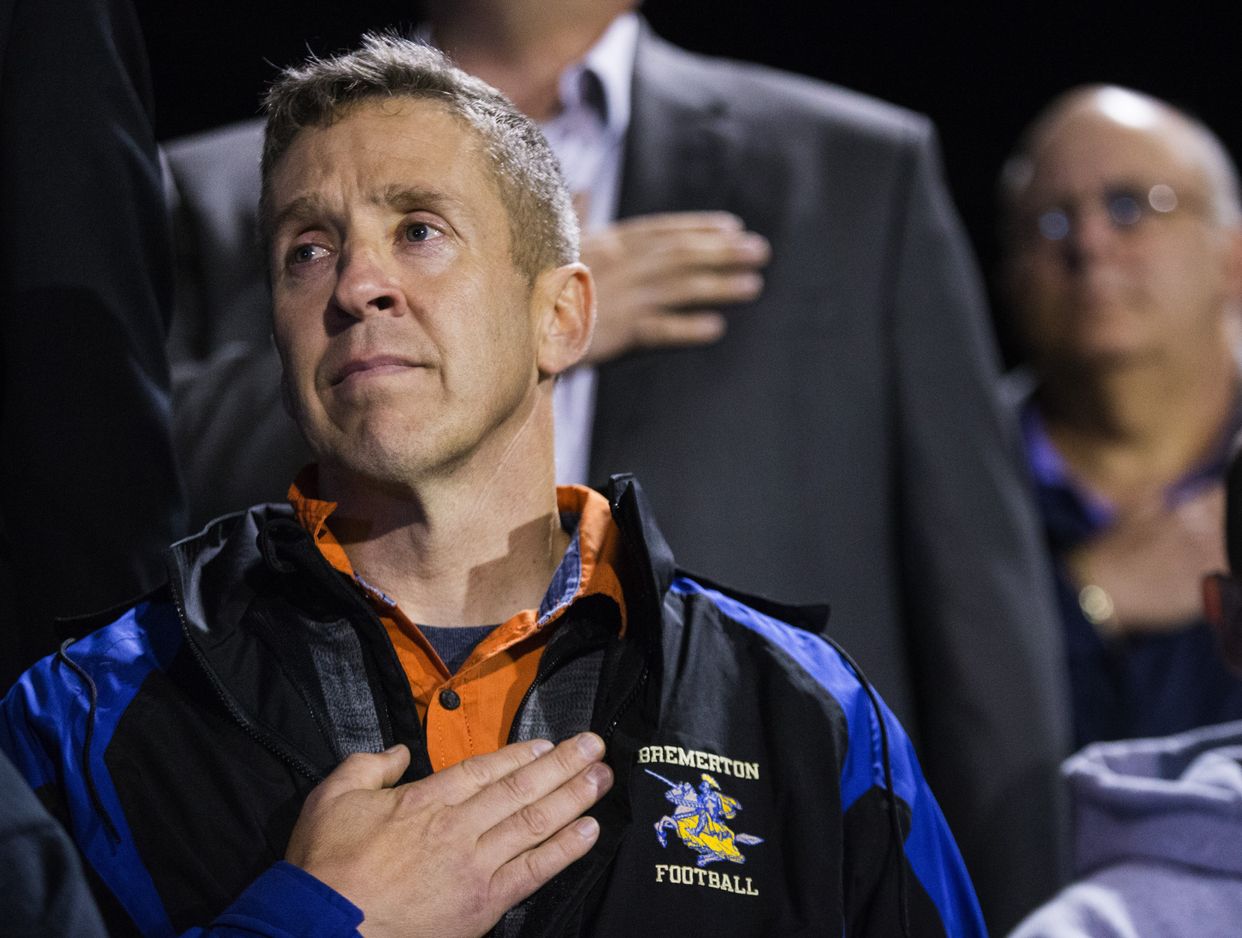
Coach Joe fields another loss

Coach Joe Kennedy (Lindsey Wasson/The Seattle Times)

Joe Kennedy, an assistant high school football coach, felt “called by God” to pray immediately after each of his team’s games, directly on the fifty-yard line. Soon, his prayer became a notable community event, garnering players and parents from both teams, and the attraction of local and national news.

After each game was over, “and after the players and coaches from both teams [ ] met to shake hands at midfield,” he proceeded to the fifty yard line of the field, knelt down, and engaged in about thirty seconds of silent prayer. Over the course of the years he coached from 2008 until 2015, more of his own players, as well as coaches, students, and parents, joined him in silent prayer. These then changed into “short motivational speeches” that included sectarian religious language. When Bremerton School District learned of this, they told Kennedy to stop the religious speeches, and that he must separate his religious exercise from the players. Kennedy followed the school’s orders for one game, but then proceeded to the same conduct as before. The coach gave multiple interviews to the news media, and after failed negotiations with the school to find common ground on religious conduct, the coach was placed on paid administrative leave, and his contract was not renewed at the end of the year.

Kennedy sued in 2016, stating that his rights to free exercise were violated by the district’s rules. Both the District Court for the Western District of Washington and the Court of Appeals for the Ninth Circuit agreed with the district, while the Supreme Court declined to hear the case. The case was sent back to the district court, and the Ninth Circuit wrote their second opinion on March 22nd. 

A January 2021 interview with Fox News
Kennedy brought three main claims before the court: free speech, free exercise, and Title I & II claims of unequal treatment. Specifically, he argued that he spoke as a private citizen, and that the district did not have “adequate justification for treating [him] differently than other members of the general public.” Kennedy claims that his speech did not coerce anyone, as it became elective and “opt-in”. To the free exercise claim, he states that the school district did not have a compelling interest to be able to regulate his religious speech. Through television interviews, Kennedy emphasized that a negative ruling here would have adverse effects for all free exercise cases.


The Ninth Circuit ruled in favor of the district. In short, the Circuit said that because he was a coach, he would not have had access to his position on the field otherwise, and thus, “Kennedy’s position encompassed his post-game speeches to students on the field.” Additionally, the fact that he continually communicated his convictions to the news media, the Circuit said, was “a continuation of his on-field demonstrative activities… that were designed to attract publicity.” He’s continued to speak about his case, including writing a Fox News op-ed in January.

Additionally, the district did have a compelling interest in regulating Kennedy’s free speech and exercise, the Circuit said: as held in Good New Club v. Milford Central School, when some state tries to avoid some Establishment Clause violation, that in and of itself can constitute a compelling interest. The possible Establishment Clause violation?  Kennedy’s prayers could have ended up coercing students towards some particular religious persuasion. Further, the speech was not private “in the context of Kennedy’s publicity leading up to it,” because of his choice of publication of the matter.

While I have reservations about part of the reasoning, I agree with the Circuit Court’s ruling in favor of the district. Ultimately, while the prayer indisputably began as a silent, individual exercise of religion, the actual “privacy” did not last throughout. The act of retooling the practice when the number and involvement of students increased inched the practice ever-closer to something that could become unconstitutional. Whether it’s the Supreme Court’s ruling against the reading of non-denominational prayers in Engel v. Vitale, private time set aside for prayer in Wallace v. Jaffree, or the student-led prayer in public schools in Santa Fe Independent School District v. Doe, ultimately, it’s clear that precedent stands against Coach Kennedy. While the free exercise of religion, as guaranteed under the First Amendment, is vital to the foundations of American democracy, Kennedy’s act treaded dangerously close to an unconstitutional establishment of religion, and as such, the school was well within their rights to end his employment. 

The only part of the decision about which I have reservations is the negotiation process of which the district tried to find a solution with Kennedy. Ultimately, I do understand that those sorts of discussions are manifestations of the “least restrictive means” provision common to the strict scrutiny standard. Kennedy found that no sort of prayer was acceptable than on the fifty yard line, immediately after the game. Telling Kennedy that other options, spaces, and times could be made available to him, treads close to government prescription of religious practice. However, the case for the district is compelling enough in other ways (speech, publicity, etc.) that, ultimately, the Circuit ruled correctly in order to ensure the vital separation of church and state.


Chebli v. Kable

    Ahmad Chebli is a Lebanese man from Michigan, father of two children, and has spent his career both as a business owner and an engineer. In 2018, Ahmad was approached by a few FBI agents, and questioned about his political beliefs, religious beliefs, what associations he was a part of, and what he did in Lebanon as a student before he moved back to his home country, the United States. The FBI agents accused Ahmad of being part of a terrorist organization, to which Ahmad immediately denied. The FBI told Ahmad that he needed to work for them due to his suspected terrorist affiliations, and if he did not agree to become an informant then he and his family would be closely monitored and investigated by the government. Ahmad refused to work for them, so as a result he was placed on the No Fly List in December 2018. Because Ahmad has been unable to fly, he cannot travel to see friends, for work, nor can he perform the Hajj pilgrimage: a religious obligation for people of Muslim faith. Ahmad has tried to fight against the FBI and remove himself from the No Fly List, but they have refused to respond or provide any evidence as to why he was even placed on there in the first place. 

    In April 2021, the ACLU filed a lawsuit on behalf of Ahmad because they believed the government had wrongly placed him on the No Fly List. The lawsuit was filed in the federal district court in Washington D.C., as the ACLU stated that this was a violation of many of Ahmad's rights. The ACLU believes that the fact that the FBI took action and placed Ahmad on the No Fly List after he refused to comply with their demands is a violation of his First Amendment rights and the Religious Freedom Restoration Act "RFRA." Ahmad holds sincere Muslim beliefs that he must perform the Hajj, thus the FBI is placing a severe burden on his religious exercise by putting his name on the No Fly List. The ACLU also states that this is a violation of the RFRA, as the FBI cannot place this burden on Ahmad unless they can prove this is the "least restrictive means of furthering a compelling government interest." 

    For many years, the United States government has been placing citizens on the No Fly List that are stigmatized as terrorism suspects. The government gives little reasoning for doing so, and these lists are disproportionately filled with Muslims and those of Arab, Middle Eastern, or South Asian dissent. Recently, the government has been pressuring Muslims more often to become informants for them but a recent Supreme Court ruling may be putting a stop to this. Similar to this case, in Tanzin v. Tanvir, three Muslim men filed a lawsuit under the RFRA after the government placed them on the No Fly List when they refused to become FBI informants. The Supreme Court unanimously ruled in favor of the Muslim men and agreed that listing them on the No Fly List burdened their free exercise of religion in violation of the RFRA. 

    Due to the ruling the Supreme Court made in Tanzin v. Tanvir, I believe the district court should side in favor of Chebli and the ACLU in this case. The exact same scenario happened in Tanzin v. Tanvir as it did in Chebli v. Kable, as in both cases Muslim men were not only put on the No Fly List for refusing to become FBI informants, but they were not given reason as to why they were put on the list. I believe it is a violation of these Muslim men's First Amendment rights in both cases to punish them for their protected-speech. Ahmad chose not to become an informant because he was neither a terrorist nor did he want to turn against his Muslim community. His refusal to be an informant and follow his ethical beliefs should not be punished because is protected under his First Amendment rights. It it also unconstitutional under the RFRA for the FBI to place Ahmad on the No Fly List because it imposes a substantial burden on the right to practice his religious exercise. Ahmad must complete the Hajj pilgrimage overseas, and he is unable to do this due to his name being on the list. I believe that under the RFRA, the government has no compelling interest to burden Ahmad in this way because they have shown no proof that he is a suspected terrorist or that he poses a threat to the nation's security.

    A counter argument one might make to my opinion is that the government has a compelling interest in putting citizens on the No Fly List because the safety of the United States outweighs the religious freedom of a citizen. I do understand that if the FBI had top secret information regarding a citizen in a terrorist organization then they might not be able to directly share that information, but because the FBI has given 0 reason to Ahmad as to why he is on the No Fly List, I do not think one can apply that logic here.

    The ruling in this case is important not only to strengthen the ruling previously made in Tanzin v. Tanvir but it is also important to minority religions. The purpose of the First Amendment is to help protect minorities, and the district court must do so in this case. If Muslim Americans are being targeted and mistreated by the FBI, it is the job of the First Amendment as well as the RFRA to protect their rights. Not only do I believe there could be some unfair religious profiling going on in this case, but also the fact that Ahmad's religious practices are being burdened by the FBI is a clear violation of the First Amendment. The FBI has not shown enough compelling interest in this case to prevent Ahmad from completing the Hajj pilgrimage.

Hunter v. U.S. Department of Education (LGBTQ+ Discrimination at Religiously Affiliated Universities)

Students from Bob Jones University, Liberty University, Baylor University and other federally funded Christian universities have filed a class action lawsuit against the United States Department of Education for unconstitutionally funding institutions with discriminatory policies against members of the LGBTQ+ community. In Hunter v. U.S. Department of Education, the plaintiff, Elizabeth Hunter is a graduate of Bob Jones University who became suicidal after being grilled for, “tweeting, ‘happy Pride,’ and for writing a book with lesbian characters.” Other plaintiffs involved in the case claim the harassment from their institutions caused them shame and depression. Students all over the country have been fined, harassed, and penalized by Christian universities for being part of the LGBTQ+ community.


The plaintiffs argue that government funds being allotted to Christian universities via federal tuition assistance empowers the universities to discriminate against people in the LGBTQ+ community. Religious exemptions are built into Title IX, which prevents gender- or sex-based discrimination in educational institutions that receive public funding. They believe the religious exemption is a violation of the Equal Protection Clause and their due process rights. Additionally, since federal financial aid is paying for the tuition of some students in-need, the government is aiding these religious institutions. The complaint filed by Hunter and the other plaintiffs suggests this violates the Establishment Clause of the First Amendment. Interestingly, the Christian universities involved in the case argue that if the Court sides with the LGBTQ+ students, their First Amendment rights would be violated. The Alliance Defending Freedom argues that, “students who attend religious schools largely do so because they wish to attend schools that share and support their beliefs. If students lose federal aid simply because they decide to attend a religious school, hundreds of thousands of them nationwide would be forced to make a choice: lose their student aid or attend a different school altogether.” One could argue that revoking federal funding from religiously affiliated universities is hostile toward religion and denies students in-need of tuition assistance their free exercise rights. 


In Bob Jones University v. United States, the Court upheld the rights of the IRS to revoke Bob Jones University’s tax-exemption status since the Christian fundamentalist values did not align with the national goals of anti-racism. The Court compared the potential burden of revoking Bob Jones University’s tax exemption to that of the United States if racial discrimination continues to perpetuate. The Court decided the United States has greater interest in abolishing racial discrimination. In United States v. Lee, Old Order Amish Edwin Lee argued that the federal requirement to pay Social Security tax was unconstitutional. Since the Amish faith believes it is a sin to no care for the elderly, Lee believed the required Social Security tax interfered with his religious obligations and therefore violated the free exercise clause. In the majority decision, Justice Burger writes, “While there is a conflict between the Amish faith and the obligations imposed by the social security system, not all burdens on religion are unconstitutional. The state may justify a limitation on religious liberty by showing that it is essential to accomplish an overriding governmental interest.” Both these cases exhibit limitations on the free exercise clause for the benefit of greater society and for the pursuit of national peace. 


This decision is one between the existing burden on the LGBTQ+ students who suffer discrimination at religiously affiliated universities and the potential burden on students at the religious universities who could lose federal financial aid. As I discussed in my last blog post, under ministerial exception, religiously affiliated institutions have the constitutional right to select their ministers as directed by their religious beliefs. However, this does not give any institution the right to harass or torture a minister if his or her identity counters the institution’s religious beliefs. Furthermore, the institution has the constitutional right to admit students with religious beliefs aligned to that of the institution, but they cannot intimidate and harass students for their gender, sex, or sexuality, and they cannot protect students who do. I believe schools have an obligation to protect all students by addressing incidents of discrimination or harassment regardless of the role of religion. As upheld by Bob Jones University v. United States and United States v. Lee, the federal government has the right to revoke fiscal support to an institution that goes against a national interest. Thirty-three plaintiffs share their stories of discrimination at religiously affiliated schools because of their gender, sex, or sexuality. The United States has taken steps in recent years to protect individuals from discrimination based on gender, sex, and sexuality under the Civil Rights Act. The Civil Rights Restoration Act of 1987 requires all federally funded organizations to abide by the Civil Rights Act. Furthermore, the Title IX Religious Exemption perpetuates discrimination abolished by the Civil Rights Act. The government continuing to fund the institution via federal student loans violates the Civil Rights Restoration Act. Because of this, I believe the Court should declare the federal funding an unconstitutional violation of the Establishment Clause and Equal Protection Clause. 


References 

Alliance Defending Freedom. 2021. Christian colleges fight lawsuit designed to strip their students of financial aid. April 12. https://adflegal.org/press-release/christian-colleges-fight-lawsuit-designed-strip-their-students-financial-aid.

Boorstein, Michelle. 2021. Dozens of LGBTQ students at Christian colleges sue the U.S. Education Dept., hoping to pressure Equality Act negotiations. March 30. https://www.washingtonpost.com/religion/christian-colleges-lawsuit-lgbtq-equality-act/2021/03/29/39343620-90af-11eb-9668-89be11273c09_story.html.

Gilreath, Ariel. 2021. Bob Jones University graduate one of dozens of LGBTQ students suing U.S. Department of Education. March 30. https://www.greenvilleonline.com/story/news/education/2021/03/30/bob-jones-university-graduate-lawsuit-us-department-education-lgbtq-students-title-ix/4808380001/.

Kramer, Sarah. 2021. This Lawsuit Threatens the Rights of Faith-Based Schools to Operate According to Their Beliefs. April 12. https://adflegal.org/blog/lawsuit-threatens-rights-faith-based-schools-operate-according-their-beliefs#close.

Payne, Kate. 2021. Two Iowa Students Among Plaintiffs Suing U.S. Department Of Ed Over LGBTQ Discrimination. April 1. https://www.iowapublicradio.org/ipr-news/2021-04-01/two-iowa-students-among-plaintiffs-suing-u-s-department-of-ed-over-lgbtq-discrimination.

Redden, Elizabeth. 2021. Religious Freedom vs. Freedom From Discrimination. April 6. https://www.insidehighered.com/news/2021/04/06/lgbt-students-sue-education-department-over-title-ix-religious-exemption.

Unites States House of Representatives. n.d. Constitutional Amendments and Major Civil Rights Acts of Congress Referenced in Black Americans in Congress. https://history.house.gov/Exhibitions-and-Publications/BAIC/Historical-Data/Constitutional-Amendments-and-Legislation/.

West, Charlotte. 2018. How Title IX Exemptions Allow Religious Colleges to Discriminate Against LGBTQ Students. October 15. https://www.teenvogue.com/story/how-religious-colleges-discriminate-lgbtq-students-title-ix-exemptions.


Eminent Domain & RFRA

    In 2017 land in Lancaster Pennsylvania was seized by the government and given to Transco, a privately owned natural gas company, in order for them to build an 183 mile extension to the Atlantic Sunrise pipeline. While many people in the community had complaints about this seizure of land especially as it wasn’t going towards building a road or something for the general public good and for/by the government the Adorers of the Blood of Christ a womans catholic ministry chose to protest and pursue legal action about this seizure of land. 

    The Adorers of the Blood of Christ have locations in various parts of the world and across the US. As part of their faith they believe that the Earth must be protected due to it being God’s creation. In 2005 the sisters created a land ethic that bid them to recognize the earth as sacred and commit themselves not to harm the earth in their use of their land as part of their Catholic faith. In 2015 the Pope made a similar decree for all those of Catholic faith.The creation of a natural gas pipeline has multiple negative effects on the earth, including of course the fact that natural gas is one of the leading causes of climate change as it is a  fossil fuel. Some of the land seized in Lancaster belonged to the Adorers local congregation. To protest this seizure and to try and prevent the land from being used for the pipeline the Sisters chose to build an outdoor chapel. In addition they also chose to pursue legal action against Transco based on the 1993 Religious Freedom Restoration Act. 

    The Religious Freedom Restoration Act(RFRA) was a bill passed to ensure that interests in religious freedom are protected. For the Adorers their main argument that they are trying to bring to court is that their faith as Christians calls them to ‘protect creation from desecration.' Sister McCann from the leadership council in St Louis explained that the sisters actively practice to reduce dependence on fossil fuels and that “When a violation is done to one part of creation, it hurts all of us.” For the Adorers their argument centers on the fact that by allowing this pipeline to be built, especially on their property, they are having their ability to practice their faith infringed upon. 

    The initial 2017 case was overturned in the 3rd Circuit Court of Appeals but the Adorers have since gone back to court in order to try and have their voices heard. This is not the first time that cases of eminent domain have been challenged on the basis of religious freedom, most notably the desecration of Native American religious sites and burial grounds such as the Dakota Access Pipeline, or Slockish v U.S. Federal Highway Administration. Unfortunately for the Adorers and others who protest eminent domain on the basis of religious freedom there tends to be a poor track record for ruling for minority religious groups.


    While I sympathize with the Adorers and their cause I do not think their argument will stand up in court. One of the main reasons for this is because the chapel was built in retaliation to the pipeline’s extension being announced as opposed to an existing chapel being seized by eminent domain. In addition, their belief is rather broad in its design and as opposing counsel has brought up, a nursing home run by the Adorers is powered with natural gas and other of their practices run contrary to this professed belief. These discrepancies can be used to judge the sincerity of their belief. In the initial 2017 ruling Judge Schmeal ruled that the Sisters had not brought up enough evidence that this pipeline violated their religious beliefs and also stated that they had not gone through proper measures to appeal the seizure of their land which is why in part, in 2019 the Supreme Court declined to hear their appeal. The current lawsuit utilizes RFRA in order to seek damages that also intersect with provisions offered by the Natural Gas Act. 

    While the current suit will not overturn the building of the pipeline or restore the land to the Adorers it may bring them some financial compensation with which they can more freely practice their commitment to doing good for the earth and preventing more damages from being done. 

Tuesday, April 6, 2021

MARRERO-MÉNDEZ V. PESQUERA

     At most staff meetings for any job, the leaders will try to close the meeting with any updates, announcements, or encouraging words.  Can a prayer be included in this list? Officer Marrero-Mendez was a police officer at the Puerto Rico Police Department.  At a meeting with a few other officers, Officer Marrero-Mendez witnessed his supervisor close the meeting with a Christian prayer.  Officer Marrero-Mendez is an atheist and did not feel comfortable participating in the prayer, which he expressed to his supervisor.  His supervisor ordered Marrero-Mendez to step aside but remain in earshot of the prayer.  Officer Marrero-Mendez refused to take part in any of the closing prayers his supervisors did and expressed to them his concerns for closing the meetings with a Christian prayer.  After expressing his concern, his supervisors took his gun away and removed him from his patrol position.  This resulted in him being reassigned to washing department vehicles and doing clerical work after working over ten years at this police department.  Officer Marrero-Mendez’s supervisors argued that their actions were justified because they were entitled to “qualified immunity”.  This is a legal shield that protects government officials, like law enforcement, from being sued if it was not established beforehand that their conduct was unconstitutional.

    This case presents the issue of whether incorporating a closing prayer at the end of the Puerto Rico Police Department meetings violates the Establishment Clause.  William Ramirez, the executive director of the ACLU in Puerto Rico explained that "government agencies cannot require employees to take part in prayer in their workplace. To do so runs afoul of one of the great pillars of both the U.S. Constitution and the Puerto Rico Constitution, which mandate separation of church and state."  The U.S. Court of Appeals for the First Circuit affirmed that the government cannot penalize someone for not participating in a prayer.  This case is unique in the sense that it is dealing with a mandatory prayer in a police department.  However, cases like Engel v. Vitale show us that the Supreme Court believes that a prayer composed by government officials is unconstitutional regardless of whether or not the prayer is optional and denominationally neutral.  Justice Black explained the dangers of having a prayer present within the governmental sphere which is exactly what is happening in this case.  He explained, “whenever government had allied itself with one particular form of religion, the inevitable result had been that it had incurred the hatred, disrespect, and even contempt of those who held contrary beliefs.”  What Justice Black feared would happen is exactly what happened to Officer Marrero-Mendez.  This case is a clear representation of government employees allying themselves with a religion through an authorized prayer at the end of meetings.  Officer Marrero-Mendez believes that the courts should order his supervisors to cease the prayer and the poor treatment he has received for not participating in the prayer.

    In my opinion, I agree with Officer Marrero-Mendez that he should not be penalized for not participating in the closing prayer.  I also believe that a prayer has no place at meetings in a police department.  Even though this prayer is not mandatory, Marrero-Mendez faced severe consequences for not participating as he was demoted from his patrol position.  This clearly violates the Establishment Clause because there are government officials creating and organizing a prayer.  In addition to creating this prayer, those who do not participate run the risk of being demoted.  I believe that Officer Marrero-Mendez should not have been demoted for refusing to participate in the prayer because it is within his free exercise rights to not be forced to pray when you don’t believe in God.  In Justice Black’s opinion in the Engel v. Vitale case, he said “the First Amendment was added to the Constitution to stand as a guarantee that neither the power nor the prestige of the Federal Government would be used to control, support or influence the kinds of prayer the American people can say,”  Using Engel v. Vitale as a precedent, I believe that the Puerto Rico Police Department should remove the prayer from the closing of their meetings.  I also believe that Officer Marrero-Mendez should assume his original position in the police department and not have to worry about losing his position for maintaining his beliefs.


Slockish v. U.S Federal Highway Administration


In 2006 the United States Federal Highway Administration announced a project to widen Highway 26 near Mount Hood, Oregon. The project site was within the vicinity of the Wildwood Recreation Area and would severely damage the traditional campsite and sacred burial grounds of the Yakama Nation. After hearing about the project, the Klickitat and Cascade Tribes of Yakama Nation requested that the government stop the development of the site. Despite negotiations and pleads from the Yakama Nation, the Federal Highway Administration began developing in July 2008. The project bulldozed ancestral burial grounds, destroyed a sacred stone altar, as well as other historic, cultural, and natural resources of religious significance. Additionally, safe access was cut off to the site while the government left the other side of the highway unharmed protecting a tattoo parlor and nearby wetlands.


The Tribes of the Yakama Nation have considered this land sacred for centuries and hereditary chiefs of the Tribes, Wilbur Slockish and Johnny Jackson, as well as a member of the Confederated Tribes of Grande Ronde, Carol Logan, filed the case against the federal government. They claim that actions made by the federal government have violated their First Amendment right to exercise their religion. Plaintiffs claim the government act causes a substantial burden and they cite the Religious Freedom Restoration Act (RFRA) of 1993. RFRA reestablishes the Sherbert test as precedent for First Amendment free exercise protections. RFRA was established as a response to the decision in Employment Division, Department of Human Resources of Oregon v. Smith in order to protect religious minorities and held that courts should use strict scrutiny to examine laws that restrict religious exercise. Despite these efforts, the court has held that the plaintiffs “have not established that they are being coerced to act contrary to their religious beliefs under the threat of sanctions or that a governmental benefit is being conditioned upon conduct that would violate their religious beliefs”. As a result, they have continually been denied claims regarding the violation of their free exercise. This case has been stalled for over a decade and as of February 2021, the Tribe members have appealed to the Ninth Circuit. 


I believe that the courts are being neglectful in their analysis of the burden imposed on the Yakama Nation. The RFRA reestablishes the Sherbert test of Sherbert v. Verner, to acknowledge the importance of over a century of case law and being critical of the laws that may impose significant burdens on individuals, specifically minorities. The RFRA remains constitutional under federal law and asks the court to make use of the Sherbert test. They should evaluate if the actions of the Federal highway administration impose a substantial burden on the religious entity, whether the state has an overriding compelling interest, and lastly if there is a least restrictive means by which the government can still serve the public interest. This case passes the first part of the test, as the Tribe no longer has safe access to the remnants of its ancestral grounds in which they have practiced ceremonies long before the nation was founded. Native American Tribes often cannot separate their beliefs from actions and most importantly separate religious belief and practice from the land they reside and protect. The government knowingly violated this sacred site of the Yakama Nation with gross disregard for the community and its religion. Additionally, the state has failed to present a compelling interest, though most importantly, there is a least restrictive means as the Natives of Mount Hood proposed reasonable alternatives to the construction plans. 


This is another display of how the federal government continues to abuse and violate Native communities. The rulings of the case so far are a display of how endangered religious minorities are if they are not adequately taken into consideration. This is seen in decisions such as Crow v. Gullet in which the court similarly ruled in favor of the state expanding a parking lot in favor of the compelling interest of health, welfare, and safety. The courts consistently undermine the significance of land as a fundamental aspect of Native American religious exercise and consequently continue to violate the free exercise clause of the First Amendment. The decisions of the court, in this case, will continue to impact others as there is currently a similar battle occurring in Arizona, Apache Stronghold v. the United States which will similarly reflect the courts’ protection of sacred Native American sites. The decisions in every one of these cases reflect the level of attention and respect that American Law has for Native people. From the decisions of the lower courts, it is evident that the aforementioned rarely exists and the persistence of cases such as Slockish v. U.S Federal Highway Administration are essential in the fight for religious minorities.


Free Speech & Pregnancy Clinics

The case before the courts today: First Resort Inc., v. Herrera, involves a Medical clinic in San Francisco, Support Circle. Support Circle provides medical care to pregnant women such as ultrasounds, pregnancy tests, counseling and various other services, but does not offer abortions. Support Circle is a “non-profit clinic and counseling center dedicated to providing support for women facing unplanned pregnancies.” Support Circle is a pro-life clinic that believes “that abortion is harmful both to women and their unborn children.” In 2011, San Francisco passed an ordinance that restricts limited service pregnancy centers, such as Support Circle, “from making false or misleading statements about the services they offer.” Support Circle is classified as a “limited service pregnancy center” because it does not provide abortions. In addition, the ordinance also states “that if search engines like Google display their website when the terms ‘San Francisco’ and ‘abortion’ are entered into the search engine together”, Support Circle would be violating the City ordinance. In 2012, Support Circle sued the city of San Francisco, citing their freedom of speech was being violated. Support Circle is arguing that their freedom of speech is being violated because of their belief of abortion. The Ninth Circuit Court of Appeals ruled in favor of the city of San Francisco. Support Circle appealed to the Supreme Court but they denied hearing the case in 2018. 

The central issue before the court concerns a private organizations first amendment right to freedom of speech. Support Circle claims that they are being denied their right to freedom of speech because of their religious and moral beliefs on abortion. Although they do not perform abortions, they want to make sure that women have access to all their options when considering the choices of an unplanned pregnancy. On the other hand, the city of San Francisco argues that this ordinance protects women from clinics that “misleadingly target women in search of abortion services through false advertising-and then employ manipulative and fear-mongering tactics on their visitors to dissuade them from obtaining abortions.” The city attorney for San Francisco stated, “These groups are entitled to be advocates, but they're not entitled to break the law. False and misleading advertising by these clinics is a deceitful practice that preys on women when they least suspect it." 

The Ninth Circuit Court of Appeals argued that the San Francisco law is “facially valid” because the speech being regulated is “unprotected false or misleading commercial speech” which is not protected by the First Amendment. This is quite the slippery slope. In this case, the court is arguing that the speech from Pro-life pregnancy clinics is false or misleading, when in reality, the speech from clinics like Support Circle is tied to their religious and moral beliefs. Do the courts have the right to decide what is or is not the “truth” when it comes to religious beliefs? In Cantwell v. State of Connecticut (1940), the Supreme Court held that the Cantwell’s were allowed to solicit for religious purposes and that by preventing them from doing so, they infringed on their First Amendment. Justice Roberts wrote, “such a censorship of religion as the means of determining its right to survive is a denial of liberty protected by the First Amendment and included in the liberty which is within the protection of the Fourteenth” (Munoz, 28).While this case is a bit different from First Resort v. Herrera, I find that the regulation of solicitation and the regulation of what is or is not “unprotected false or misleading commercial speech” are quite similar. 

    I disagree with the decision of the Ninth Circuit Court of Appeals. I understand the city of San Francisco’s argument about preventing pro-life clinics from “manipulating” pregnant women, however, the law clearly targets pro-life clinics in San Francisco. By claiming to protect a woman’s right to choose, the state of San Francisco is taking away the choice of having access to pro-life options and support like Support Circle, which is making a choice and not letting her choose. On Support Circle’s website, they share their beliefs on abortion as well as options for women considering abortion and their other services, they also state that while they do not prescribe emergency contraceptives or perform abortions, they share information about them both and note that they support a woman’s right to choose. I would be curious to hear how the Supreme Court would rule on this issue. Although they declined to hear the case, they ruled on another case concerning the rights of pro-life pregnancy clinics and the legality of forcing them to advertise abortion options within the state. The Supreme Court ruled in favor of the pregnancy clinic. The restriction of free speech, and the regulation of what does or does not count as “truth,” cannot be seen as constitutional. For this reason, I side with Support Circle.